What Is an Asbestos Survey? (UK Guide for Homeowners, Landlords & Businesses)
What Happens During an Asbestos Survey?
A practical guide to how an asbestos survey is prepared, what the surveyor looks for, how suspect materials are sampled and what you should do with the report afterwards.
This guide explains the survey process. If you are trying to decide which survey your property or project actually requires, use ASM's main survey service guide instead.
What actually happens during an asbestos survey?
An asbestos survey is a structured inspection of an agreed building, area or work scope. The surveyor examines materials that could contain asbestos, records their location and condition, takes representative samples where appropriate and identifies any areas that could not be inspected.
Samples are analysed by an appropriately accredited asbestos laboratory. The resulting survey report brings the inspection findings, laboratory results, photographs, assessments, access restrictions and recommended actions together.
The important point is that the report only answers the question it was commissioned to answer. A survey designed for normal occupation should not automatically be treated as suitable information for intrusive refurbishment or demolition.
Survey purpose comes first
Before inspecting the building, the surveyor needs to understand why the survey is being commissioned.
This may be to support:
- Normal building occupation and maintenance
- An asbestos register or management arrangements
- Refurbishment or alteration works
- Demolition or major strip-out
- Investigation of a particular area or material
A good asbestos survey starts with the right information
Survey quality is heavily influenced by planning. The surveyor should know what the report will be used for and which parts of the property need to be inspected before arriving on site.
Define the reason
Explain whether the building will remain occupied, undergo maintenance, be refurbished or be demolished.
Provide previous records
Existing surveys, asbestos registers, removal records and earlier laboratory results can help establish what is already known.
Provide plans
Floor plans, refurbishment drawings and marked work areas help the surveyor understand the intended inspection boundary.
Arrange access
Locked rooms, ceiling voids, plant rooms, lofts, roofs and service areas should be accessible where they form part of the survey scope.
Explain planned works
For refurbishment projects, provide the actual proposed works rather than simply asking for a general survey of the building.
Identify constraints
Occupancy, live services, high-level areas, security requirements and sensitive rooms may all affect how the inspection is planned.
Why access restrictions matter
Areas that cannot be inspected create uncertainty. HSE warns that survey restrictions can seriously undermine the usefulness of the information. Uninspected areas may need to be presumed to contain asbestos until appropriate access or further investigation can be completed.
What does the asbestos surveyor do?
The exact level of inspection depends on the agreed survey type and scope, but the basic process follows a logical sequence.
Confirm the scope
The surveyor confirms the building or work area, available information, access arrangements and any relevant limitations.
Inspect systematically
Rooms and building elements within scope are inspected for materials that could contain asbestos.
Record suspect materials
Material type, location, extent, condition and other relevant information are recorded against clear property references.
Take samples where required
Representative samples of suspect materials may be taken using suitable controls so their asbestos content can be determined.
Record limitations
Areas that cannot be inspected or accessed should be clearly identified rather than silently omitted from the report.
Compile the report
Inspection records and analytical results are combined into a report that can be used for the purpose agreed before the survey.
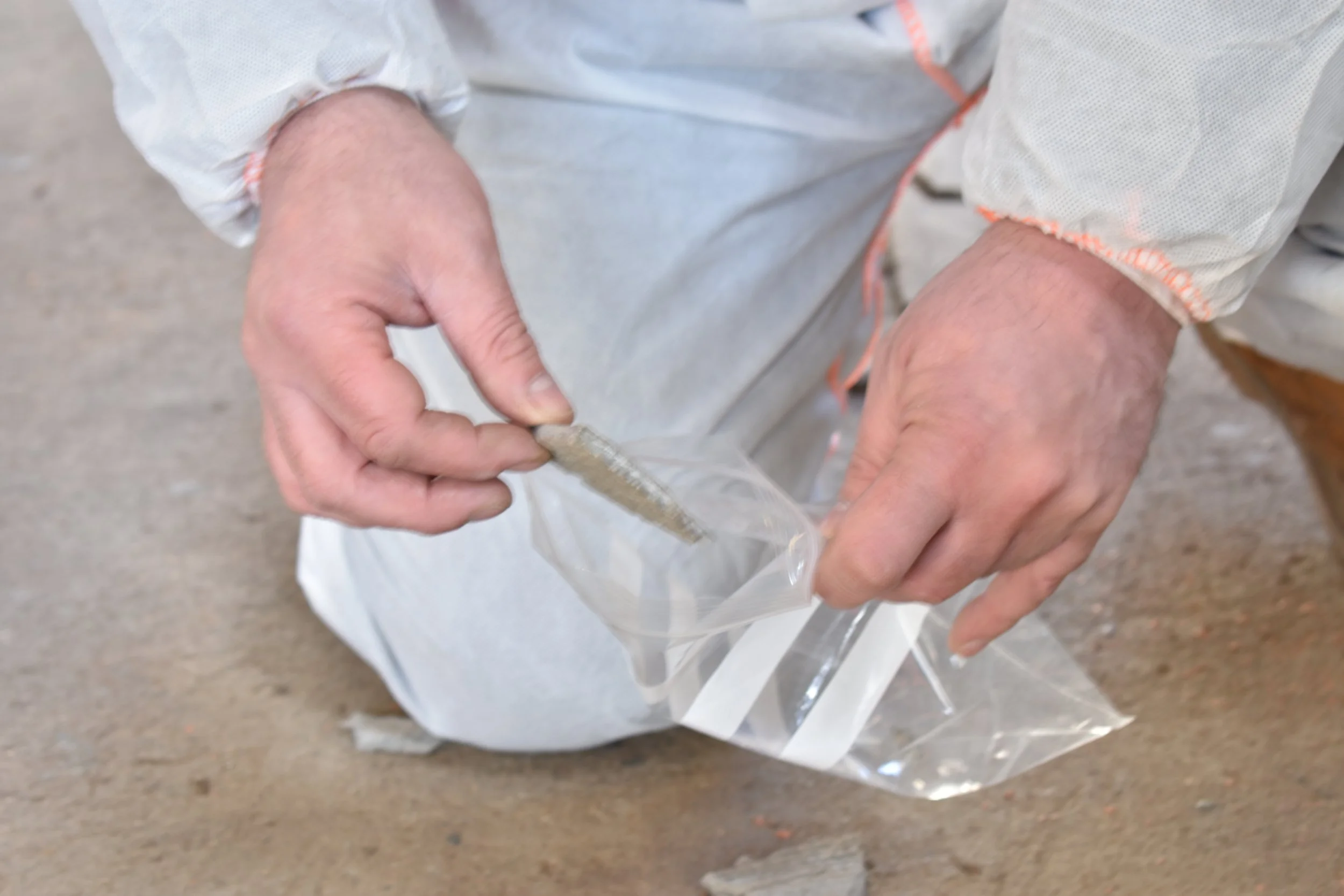
Can a surveyor identify asbestos just by looking at it?
An experienced surveyor can recognise many materials that are commonly associated with asbestos, but visual inspection alone does not normally confirm whether a suspect material actually contains asbestos fibres.
Representative samples may therefore be collected and analysed by an appropriately accredited laboratory.
In some circumstances a material may instead be presumed to contain asbestos and managed accordingly.
What should an asbestos survey report contain?
A useful report needs to show not only which samples tested positive, but also exactly what was inspected, where materials were found and where uncertainty still remains.
- Property and survey details
- Survey type and agreed scope
- Areas and buildings inspected
- Known or presumed ACM locations
- Material descriptions
- Approximate extent or quantity where relevant
- Photographs and location references
- Sample references and laboratory results
- Material assessments where applicable
- Areas not accessed
- Survey restrictions and limitations
- Recommendations and further actions
An asbestos survey does not mean a building is “asbestos free”
The survey has a boundary
Its conclusions relate to the areas, buildings and materials covered by the agreed inspection scope.
Access may be restricted
Concealed or inaccessible locations may remain uncertain and should be clearly recorded in the report.
Future work can change the requirement
A report suitable for normal occupation may not contain enough intrusive information for a later refurbishment project.
Check the survey against the work before contractors start
If refurbishment, strip-out or demolition is being planned, the asbestos information should be reviewed against the precise work area and the building elements that will be disturbed.
Do not assume an existing Management Survey automatically covers future intrusive work.
Which survey route does your project need?
This article explains how the survey process works. The detailed service pages below explain the different survey scopes and when each is appropriate.
Management Survey
Used to support the management of asbestos during normal occupation, routine maintenance and foreseeable activity.
Management Survey details →Refurbishment Survey
Intrusive investigation targeted specifically at the areas and building elements affected by proposed refurbishment.
Refurbishment Survey details →Demolition Survey
Intrusive investigation of the defined demolition area to locate ACMs before demolition and associated asbestos removal planning.
Demolition Survey details →Re-inspection
Reviews the current condition of asbestos-containing or presumed materials already recorded within existing asbestos information.
Re-inspection details →What should you do with an asbestos survey?
The report should support a decision. It should not simply be filed away and forgotten.
Update the asbestos register
Where Regulation 4 applies, relevant known and presumed asbestos information should form part of the current asbestos register.
What is an asbestos register? →Manage materials left in place
Asbestos in suitable condition may often remain in place when it can be effectively managed and protected from disturbance.
Asbestos Management Plans →Plan work around the findings
Contractors should receive relevant asbestos information before maintenance or other activities that could disturb the building fabric.
Survey found asbestos: what next? →Does finding asbestos mean it has to be removed?
No. A positive asbestos result does not automatically mean that every asbestos-containing material must be removed.
Material can sometimes remain in place
Where asbestos is in suitable condition, protected from disturbance and capable of being effectively managed, leaving it in place may be appropriate.
Planned work may change the decision
Removal, repair, encapsulation or other controls may be appropriate where materials are damaged, vulnerable or will be affected by future work.
What if suspect asbestos is discovered or damaged during work?
Stop the activity and prevent unnecessary disturbance of the affected material or debris. Do not sweep suspect asbestos debris or use an ordinary domestic vacuum cleaner.
The appropriate next step may involve inspection, material sampling, controlled cleaning, asbestos removal or analytical monitoring depending on what has happened.
Official asbestos survey guidance
HSE — Arrange an Asbestos Survey
HSE guidance covering survey purpose, Management Surveys, Refurbishment or Demolition Surveys, surveyor competence and sampling.
Read HSE guidance →HSG264 — The Survey Guide
HSE's detailed technical guidance covering asbestos survey planning, inspection, sampling, reporting and survey quality.
Read HSG264 →ASM Survey Services
Compare ASM's Management, Refurbishment, Demolition and Re-inspection routes and find the appropriate service for your property or project.
Visit Asbestos Survey Services →Questions about what happens during an asbestos survey
Does an asbestos survey involve taking samples?
Often, yes. Representative samples of suspect materials may be required to determine whether they contain asbestos. In some circumstances a material may instead be presumed to contain asbestos and managed accordingly.
Can asbestos be confirmed by looking at a material?
Visual inspection can identify materials that are suspicious or characteristic of known asbestos products, but asbestos content normally needs laboratory analysis of a representative sample to be confirmed.
Does the surveyor inspect every part of the building?
Only the areas included within the agreed scope and accessible using the planned survey method can be inspected. Any significant restrictions or inaccessible areas should be recorded clearly in the report.
What does “no access” mean on an asbestos survey?
It means the surveyor could not inspect that location during the survey. The absence of a recorded ACM in a no-access area should not be interpreted as confirmation that asbestos is absent there.
Can an old Management Survey be used before refurbishment?
Not automatically. The existing information must be checked against the exact proposed work. Where intrusive work could expose concealed asbestos, a suitably scoped Refurbishment Survey may be required.
Does a positive asbestos sample mean the material must be removed?
No. The appropriate action depends on the material, condition, location, likelihood of disturbance and future plans for the area. Some materials can remain safely managed in place.
What should I do after receiving an asbestos survey report?
Review the findings, limitations and recommendations. Where applicable, update the asbestos register and management arrangements, communicate relevant information to anyone who may disturb the material and confirm that the survey remains suitable before future intrusive works.
How do I know which asbestos survey I need?
The correct survey depends mainly on what will happen to the building. ASM's main asbestos survey page compares Management, Refurbishment, Demolition and Re-inspection routes in detail.
Need to move from guidance to an asbestos survey?
Use the main ASM survey hub to compare survey types, understand when each is required and find the relevant local survey team.