Is It Safe to Live in a House with Asbestos?
Yes — in many cases asbestos-containing materials can remain safely managed within a home when they are in good condition, protected and unlikely to be disturbed.
The presence of asbestos alone does not normally mean you need to leave the property or remove every ACM. The important questions are what the material is, what condition it is in and whether somebody is likely to disturb it.
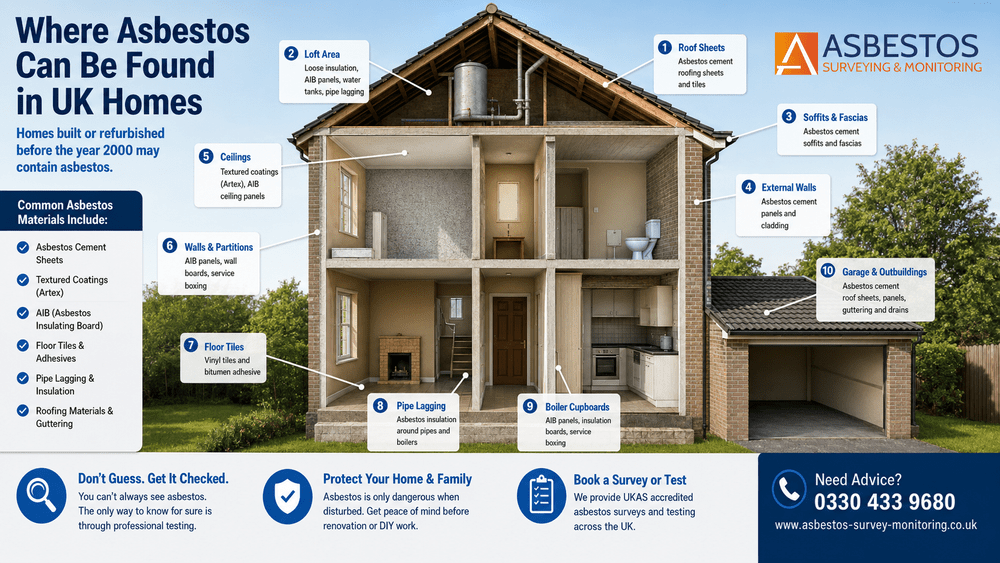 Image: ASM house asbestos location guide
Can you safely live in a house containing asbestos?
Think about asbestos as a condition and disturbance problem, not simply a presence-or-absence problem.
When is asbestos generally lower risk in a home?
HSE says that when asbestos is in good condition and is not disturbed, the risk of exposure is extremely low.
Material is intact
It is not broken, crumbling, badly weathered, delaminating or producing visible debris.
Unlikely to be damaged
Its position or physical protection makes accidental knocks, abrasion or other disturbance unlikely.
It will be left alone
Nobody is planning to drill, cut, sand, scrape or otherwise disturb the material.
HSE guidance explains that where asbestos is in good condition, well protected and unlikely to be disturbed, leaving it in place and managing it can be safer than unnecessary removal.
When does asbestos in a house become a greater concern?
It is damaged
Broken edges, cracks, impact damage or deterioration can increase the potential for fibre release.
It is drilled or cut
Power tools can turn a previously stable ACM into a significant disturbance event.
It is sanded or scraped
Abrasive work can generate dust and should not be carried out on unidentified suspect materials.
Refurbishment is planned
Work behind walls, ceilings, floors, cupboards and service areas may encounter asbestos hidden from normal view.
Water damage occurs
Leaks can damage boards, ceilings and other asbestos-containing materials that were previously stable.
It is frequently touched
Low-level panels, cupboards and exposed materials can be more vulnerable to repeated accidental contact.
Removal is attempted
Incorrect removal can produce considerably more disturbance than leaving a stable material alone.
The material is friable
Materials such as lagging, sprayed coatings and some insulation products can release fibres more readily than strongly bonded asbestos cement.
What asbestos-containing materials might be in a house?
You cannot confirm asbestos reliably from appearance alone, but these are common examples found in older UK property.
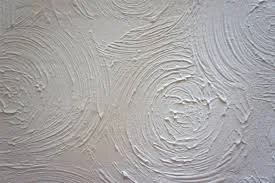
Image: ASM reference photograph.
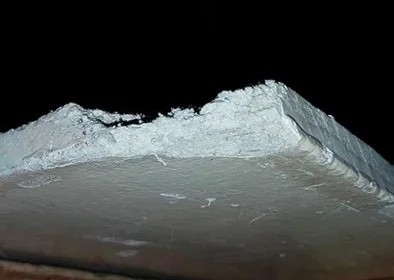
Image: ASM reference photograph.
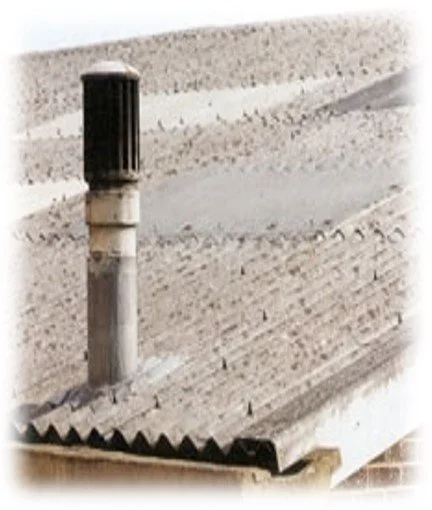
Image: ASM reference photograph.
Where might asbestos be found around the home?
Ceilings
Textured coatings, AIB panels and concealed materials above suspended or false ceilings.
Flooring
Thermoplastic or vinyl tiles, backing materials and some older bitumen adhesives.
Boiler cupboards
AIB, old pipe insulation, heat-resistant products and service boxing.
Bathrooms
Bath panels, floor finishes, boxing and older ceiling materials.
Garages
Corrugated asbestos cement roofs, wall sheets, gutters and flues.
Lofts
Boards, tanks, pipe insulation, flues and other historic materials.
Soffits
Asbestos cement and AIB can both occur in external soffit construction.
Walls & partitions
AIB panels, service boxing, fire-resistant linings and hidden materials.
Should asbestos always be removed from a house?
No. The appropriate response depends on the material, condition, location and future plans for the property.
Leave in place
An intact ACM that is protected and unlikely to be disturbed may be suitable to remain in place.
Repair or encapsulate
Some materials can be sealed, enclosed or physically protected where this provides an appropriate long-term solution.
Controlled removal
Removal may be appropriate where the material is damaged, deteriorating, vulnerable or in the way of planned building work.
Asbestos Removal →Asbestos removal can fall into licensed, notifiable non-licensed or non-licensed categories. Do not assume every product has the same removal requirements.
Do you need asbestos testing or a full survey?
One suspect material
If you simply need to know whether one ceiling coating, board, floor tile or roof sheet contains asbestos, targeted sampling may be appropriate.
Asbestos Sampling →Several areas of the house
A wider asbestos survey can provide more useful information where several areas or materials need to be considered.
Asbestos Surveys →Refurbishment planned
Where walls, floors, ceilings or other building fabric will be opened up, the survey needs to be scoped specifically to the work.
Refurbishment Survey →Is it safe to renovate a house containing asbestos?
It can be — but only when the asbestos risk has been properly investigated before intrusive work starts.
A material that presents very little risk while sitting untouched behind a wall can become a very different problem when that wall is drilled, cut or demolished.
Define the work
Identify which ceilings, walls, floors, services, roofs or other building elements will be disturbed.
Check for asbestos
Make sure the asbestos information specifically covers those materials and locations.
Plan the response
Remove, protect or otherwise manage identified ACMs before construction work affects them.
Should you buy a house that contains asbestos?
Finding asbestos does not automatically mean a property should be avoided. The more useful question is what the identified materials will mean for occupation, maintenance and your future plans.
Condition
Are identified ACMs sound and protected, or are they damaged and likely to require remedial work?
Future refurbishment
A material that can remain safely managed today may need removing when you later remodel a kitchen, bathroom or loft.
Budget
Understand any likely survey, management or removal costs before allowing asbestos to affect your property decision.
Where a specific asbestos question needs answering, use targeted asbestos sampling or an appropriate survey.
What if asbestos has already been disturbed?
Stop the activity and avoid making the situation worse through unnecessary cleaning or further disturbance.
Stop work
Stop drilling, sanding, scraping, cutting or handling the suspect material.
Keep people away
Prevent unnecessary access to the affected area.
Do not sweep
Do not dry-sweep debris or use a normal household vacuum cleaner.
Get advice
Establish what was disturbed and whether sampling, cleaning, removal or air monitoring is appropriate.
Does a private homeowner legally need an asbestos survey?
A private owner-occupied house does not automatically need a Management Asbestos Survey simply because it was built before 2000.
Regulation 4's specific Duty to Manage applies to non-domestic premises and common parts of multi-occupancy domestic premises rather than the private domestic areas of an owner-occupied house.
However, when builders, electricians, plumbers and other trades carry out work, the asbestos risk still needs to be controlled under the asbestos and health-and-safety requirements that apply to their work.
If your home was built or refurbished before 2000 and you are about to disturb unknown building materials, investigate the asbestos risk before the work starts rather than after something has been drilled, cut or removed.
What if the house is rented or part of a block?
Landlords
Landlords and property managers should consider asbestos when maintenance, repair or refurbishment could expose tenants, contractors or others.
Asbestos Surveys for Landlords →Blocks of flats
Regulation 4 can apply to common parts such as corridors, staircases, lifts, plant areas and other shared building fabric.
Block of Flats Guide →Simple asbestos decision guide for homeowners
| Situation | Likely next step |
|---|---|
| Known asbestos, intact and no work planned | It may be appropriate to leave the material in place and avoid disturbance. |
| One suspect material needs identification | Consider targeted professional asbestos sampling. |
| Several areas of an older property need checking | Consider a suitably scoped asbestos survey. |
| Renovation will disturb walls, floors or ceilings | Obtain asbestos information specifically covering the work area, potentially through a Refurbishment Survey. |
| Asbestos is damaged | Obtain competent assessment. Repair, protection, cleaning or removal may be required. |
| Suspect asbestos has already been drilled or broken | Stop work, restrict access and obtain incident-specific advice. |
| Removal is required | Determine the correct work classification and competent removal method for the material and task. |
Related ASM services and guides
Does My House Have Asbestos?
Property-age indicators, suspect materials and how to confirm whether asbestos is present.
Read the Guide →Where Is Asbestos Found in a House?
Room-by-room guide covering ceilings, floors, bathrooms, kitchens, garages, lofts and service areas.
Room-by-Room Guide →Is Asbestos Only in Old Houses?
Understand property age, refurbishment history and the important pre-2000 cut-off.
Property Age Guide →What Does Asbestos Look Like?
Real examples of AIB, textured coatings, cement, lagging, floor tiles and other ACMs.
Asbestos Photo Gallery →Asbestos Testing
Targeted investigation where a specific suspect material needs identifying.
Asbestos Testing Near Me →Asbestos Sampling
Professional sampling and laboratory analysis of suspect building materials.
Asbestos Sampling →Asbestos Surveys
Wider asbestos inspection where several areas or planned works need to be considered.
Asbestos Surveys UK →Refurbishment Survey
Intrusive asbestos investigation before alteration or renovation.
Refurbishment Surveys →Survey Before Renovation?
Understand what needs to be checked before kitchen, bathroom, rewiring, structural or other intrusive works.
Renovation Guide →Asbestos Removal
Controlled removal where asbestos cannot reasonably remain in place.
Asbestos Removal →Removal Costs
Current UK guide prices for garage roofs, floor tiles, Artex, AIB, lagging and larger projects.
Removal Cost Guide →Accidental Disturbance
What to do if you have already drilled, broken or damaged a suspect asbestos material.
Disturbed Asbestos Guide →HSE and UKHSA asbestos guidance for homeowners
HSE Homeowner FAQs
HSE guidance covering asbestos in domestic property, leaving intact ACMs in place, DIY and contractor work.
HSE Asbestos FAQs →HSE Asbestos Safety
Guidance on when asbestos presents a risk and activities that commonly disturb building materials.
HSE Asbestos Safety →UKHSA Householder Guidance
Public-health guidance covering asbestos exposure and asbestos materials within homes.
UKHSA Asbestos Guidance →Find an ASM asbestos survey team near you
Frequently asked questions
Is it safe to live in a house with asbestos?
It can be. Asbestos-containing materials that are in good condition, protected and unlikely to be disturbed can often remain safely managed in place. The risk increases when asbestos is damaged, deteriorating or disturbed.
Is asbestos dangerous if left alone?
HSE says the risk of exposure is extremely low where asbestos is in good condition and not disturbed. UKHSA similarly advises that intact asbestos materials in locations where they are unlikely to be disturbed should not cause harm.
Should asbestos always be removed from a house?
No. Intact asbestos that is unlikely to be disturbed can often be left in place. Removal may be appropriate where the material is damaged, deteriorating, vulnerable or affected by planned work.
How do I know if my house contains asbestos?
Homes built or refurbished before 2000 may contain asbestos. Appearance alone cannot reliably confirm it. A representative sample or appropriately scoped asbestos survey can provide confirmation.
Can I tell asbestos by looking at it?
No. Many asbestos-containing products closely resemble modern non-asbestos materials. Laboratory analysis of a representative sample is needed to confirm whether that material contains asbestos.
Is asbestos safe if it has been painted over?
A sound sealed or painted surface can reduce the likelihood of fibre release, but the underlying material remains asbestos. Avoid drilling, sanding, scraping or otherwise disturbing it without appropriate assessment.
Can I do DIY in a house that contains asbestos?
DIY can change a low-risk situation into an exposure risk if asbestos is drilled, cut, sanded, scraped or broken. Suspect materials should be identified before intrusive work begins.
Do I need an asbestos survey before renovating my house?
If intrusive work in a pre-2000 property could disturb asbestos, suitable asbestos information should cover the exact building fabric affected. A properly scoped Refurbishment Asbestos Survey may be appropriate.
Can I buy a house that contains asbestos?
Asbestos does not automatically make a property unsuitable to buy. Consider the material type, condition, future refurbishment plans and any likely management or removal costs before making a decision.
What should I do if asbestos in my house is damaged?
Avoid further disturbance and unnecessary access. Do not dry sweep the debris or use an ordinary household vacuum cleaner. Obtain competent advice to determine whether testing, specialist cleaning, repair or removal is required.
Do I need an air test if asbestos is in my house?
Not simply because intact asbestos is present. Air monitoring is used to answer specific questions, such as following suspected disturbance or remedial work. It does not replace identifying and controlling the asbestos source.
Is asbestos cement lower risk than AIB or pipe lagging?
Asbestos cement is a strongly bonded material and generally has lower fibre-release potential when intact than more friable materials such as pipe lagging, sprayed coatings or asbestos insulating board. All ACMs still need appropriate handling.
Does a private homeowner legally need an asbestos survey?
A private owner-occupied house does not automatically require a Management Survey simply because it may contain asbestos. However, asbestos should be considered before intrusive building work, particularly where contractors or tradespeople are involved.
Can asbestos be encapsulated instead of removed?
Sometimes. Depending on the material, condition and location, sealing, encapsulation or enclosure may form part of an appropriate management strategy. Professional assessment should determine whether this is suitable.
Find out what it is before deciding whether to remove it
Send ASM your property postcode, approximate property age, photographs of the suspect material where safe, its location and details of any planned building work. We can help identify whether targeted sampling, a wider asbestos survey or removal advice is the appropriate next step.