Where Is Asbestos Found in UK Homes? Room-by-Room Guide Before Renovation
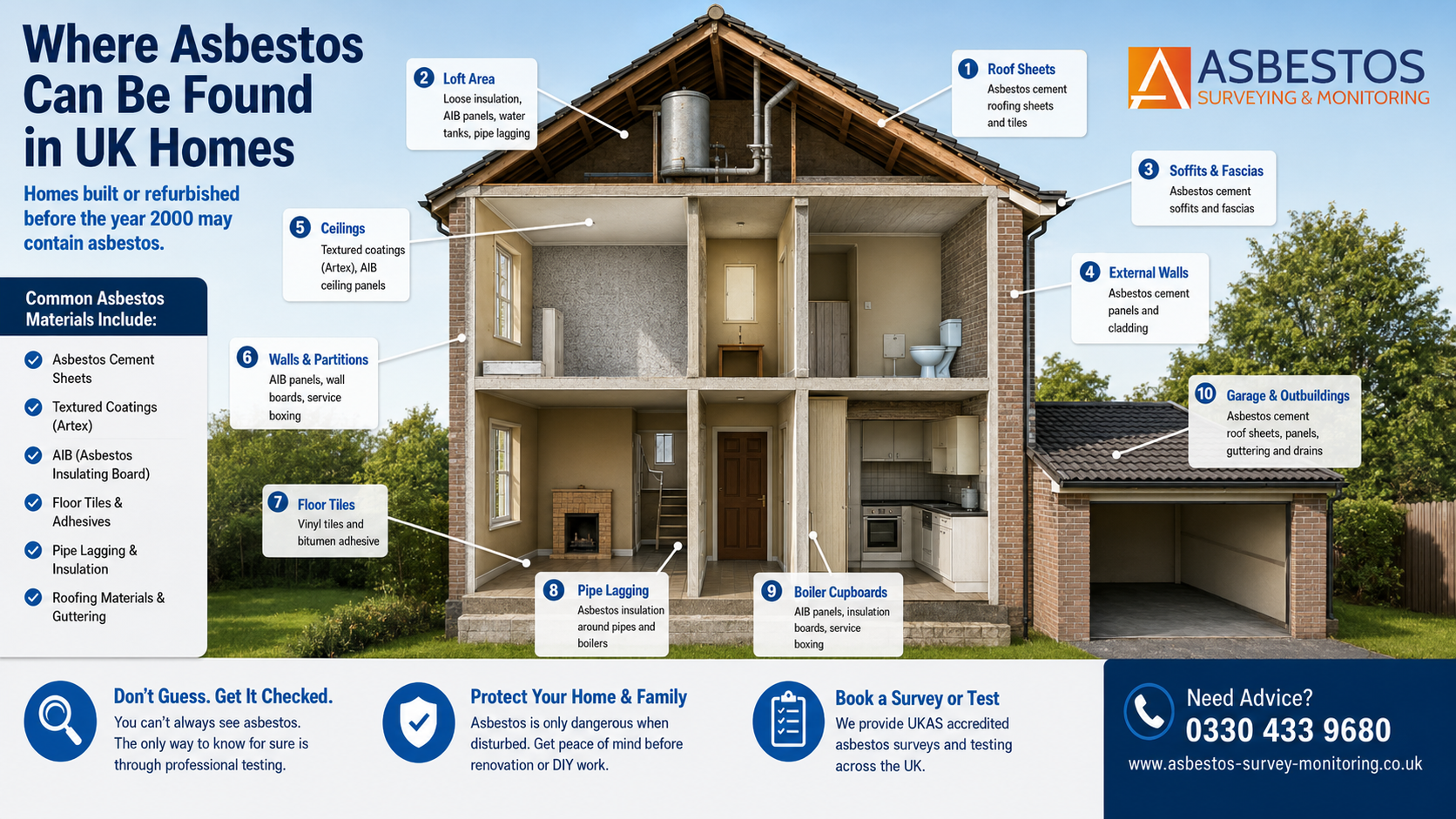
If your home, flat, garage or outbuilding was built or refurbished before the year 2000, asbestos could still be present in hidden or everyday building materials.
Many people think asbestos is only found in old factory roofs or obvious pipe lagging, but it can also be present in ceilings, floor tiles, textured coatings, soffits, garage roofs, wall boards, service boxing, loft areas, cupboards, bathrooms and kitchens.
This guide explains where asbestos is commonly found in UK homes, what materials to be careful around, and when you should arrange an asbestos survey, asbestos sample test, or professional asbestos advice before starting work.
The Health and Safety Executive provides official guidance and diagrams showing where asbestos can occur in buildings, including residential properties built or refurbished before 2000: HSE asbestos location diagrams.
Why Asbestos Can Still Be Found in UK Homes
Asbestos was widely used in UK building materials because it was strong, heat resistant, fire resistant and durable. It was used in homes, flats, garages, schools, offices, factories, public buildings and commercial properties.
Although asbestos is now banned in the UK, many older buildings still contain asbestos-containing materials, also known as ACMs.
Asbestos is not always dangerous just because it is present. The risk increases when asbestos-containing materials are damaged, drilled, sanded, cut, scraped, broken, removed or disturbed during building work.
This is why asbestos checks are particularly important before:
Kitchen refurbishments
Bathroom refurbishments
Rewiring
Boiler replacements
Central heating upgrades
Loft works
Garage roof removal
Flooring works
Ceiling works
Wall removal
Extensions
Demolition
General renovation
Insurance reinstatement works
Solar panel installation
Roof repairs
Pipework alterations
If you are planning intrusive works, you may need a Refurbishment Asbestos Survey before the work starts.
Quick Answer: Where Is Asbestos Most Commonly Found in a House?
In UK homes, asbestos is commonly found in:
Textured coatings, including some Artex ceilings
Floor tiles and bitumen adhesive
Garage roofs and asbestos cement sheets
Soffits, fascias and external panels
Asbestos insulating board, also known as AIB
Pipe boxing and service risers
Old water tanks
Flue pipes
Bath panels
Toilet cisterns
Roofing felt
Electrical backing boards
Boiler cupboards
Airing cupboards
Loft insulation boards or roof lining materials
Outbuildings, sheds and garages
You cannot confirm asbestos by looking at it. Many asbestos-containing materials look similar to non-asbestos materials. The only reliable way to confirm asbestos is through proper sampling and laboratory analysis.
For single-material checks, see our Asbestos Sample UK service.
For full property checks, see our Asbestos Survey UK service.
Room-by-Room Asbestos Guide for UK Homes
1. Asbestos in Living Rooms and Bedrooms
Living rooms and bedrooms can contain asbestos in ceilings, walls, floors, fireplaces, boxing and older decorative finishes.
Common asbestos-containing materials may include:
Textured coating to ceilings or walls
AIB panels around fireplaces
AIB boxing around pipes
Asbestos-containing floor tiles
Bitumen adhesive beneath floor tiles
Old heater panels
Electrical backing boards
Ceiling tiles
Panels behind radiators
Fire-resistant boards near chimney breasts
What to watch for
Be careful before drilling, sanding, scraping, removing ceilings, taking down boxing, replacing floors, removing fireplaces or disturbing old wall panels.
Textured coatings are especially common in older properties. They may contain low levels of asbestos, but risk can increase if they are sanded, scraped or drilled.
For image examples, see our existing guide: What Does Asbestos Look Like? UK Photo Gallery.
2. Asbestos in Kitchens
Kitchens are one of the most common areas for asbestos to be disturbed during refurbishment. This is because kitchen upgrades often involve removing floors, ceilings, wall tiles, cupboards, service boxing, pipework and old appliances.
Possible asbestos locations include:
Floor tiles
Bitumen adhesive below flooring
Textured ceiling coatings
AIB panels behind boilers
AIB fireproof panels
Pipe boxing
Service ducts
Boiler cupboard panels
Old flue pipes
Wall boards
Fuse board backing panels
Panels behind old heaters
Ceiling voids
Old Aga type cooker hot plate surrounds and seals
Why kitchen refurbishments are higher risk
Kitchen works often involve multiple trades, including plumbers, electricians, joiners, flooring contractors and decorators. If asbestos has not been identified before work starts, it can be accidentally disturbed.
If you are replacing a kitchen in a property built before 2000, you should consider a targeted Refurbishment Asbestos Survey before work begins.
3. Asbestos in Bathrooms
Bathrooms can contain asbestos in flooring, walls, boxing, bath panels, ceilings and pipework areas.
Common bathroom asbestos locations include:
Vinyl floor tiles
Bitumen floor adhesive
Textured ceilings
Bath panels
AIB panels
Toilet cisterns
Pipe boxing
Service risers
Ceiling boards
Wall panels
Panels around hot water systems
Asbestos cement water tanks in nearby loft spaces
What to check before bathroom works
Bathroom refurbishment often involves stripping tiles, removing boxing, changing pipework, replacing ceilings, lifting floors and drilling walls. These works can disturb hidden asbestos-containing materials.
Before bathroom refurbishment, arrange suitable asbestos checks if the property was built or refurbished before 2000.
4. Asbestos in Hallways, Stairs and Landings
Hallways, stairwells and landings can contain asbestos in ceilings, wall panels, fire protection boards, pipe boxing and floor finishes.
Possible asbestos materials include:
Textured coatings
AIB panels
Fireproof boards
Ceiling tiles
Under-stair panels
Pipe boxing
Electrical backing boards
Floor tiles
Bitumen adhesive
In flats and blocks of flats, communal corridors, stairwells, risers, meter cupboards and plant areas can also be subject to asbestos management duties.
If you own or manage a block of flats, see our guide: Do I Need an Asbestos Survey for My Block of Flats?.
For landlord and managing agent support, see Asbestos Surveys for Landlords.
5. Asbestos in Lofts and Roof Spaces
Lofts and roof spaces can contain asbestos in water tanks, pipe insulation, roof lining, insulation boards, flues, debris and old stored materials.
Common loft asbestos locations include:
Asbestos cement water tanks
Pipe lagging
AIB panels
Old flue pipes
Roof lining materials
Soffit boards
Debris from previous works
Stored asbestos cement materials
Insulation board offcuts or flue surrounds
Fire protection boards
Cement Panels
Be careful before loft work
Loft works may involve insulation upgrades, electrical work, boiler flues, storage boarding, roof repairs, solar panel works or conversion projects. These activities can disturb hidden asbestos materials.
Do not assume a loft is asbestos-free because the main rooms look modern. Some asbestos materials are hidden above ceilings, around tanks, behind boards or within service areas.
6. Asbestos in Garages and Outbuildings
Garages, sheds and outbuildings are common locations for asbestos cement products.
Possible asbestos locations include:
Corrugated garage roof sheets
Flat asbestos cement sheets
Wall cladding
Fascia boards
Soffit boards
Flue pipes
Asbestos cement gutters
Downpipes
AIB Ceilings or Tiles
Old panels
Debris from broken sheets
Asbestos cement is often lower risk than AIB or pipe lagging when intact, but it can still release fibres if broken, drilled, cut, smashed or pressure washed.
If you need garage roof removal pricing, see our Asbestos Removal Cost UK guide.
If you need removal support, see Asbestos Removal UK.
7. Asbestos in Floors
Older floors can contain asbestos in tiles, adhesives, paper backing, screeds, bitumen products and underlay materials.
Common asbestos floor materials include:
Vinyl floor tiles
Thermoplastic floor tiles
Bitumen adhesive
Paper backing to old flooring
Floor levelling compounds in some situations
Debris beneath old floor layers
Debris or hidden asbestos within floor voids
Flooring works can become higher risk if materials are scraped, ground, mechanically sanded or broken up. Before lifting older floor tiles or grinding adhesive, consider asbestos sampling.
For material testing, visit Asbestos Sample UK.
For testing prices, see Asbestos Sample Cost UK.
8. Asbestos in Ceilings
Ceilings can contain asbestos in textured coatings, ceiling tiles, AIB panels, fire protection boards and debris above ceiling voids.
Common ceiling-related asbestos materials include:
Textured coating
Ceiling tiles
AIB ceiling panels
Fire protection boards
Debris above suspended ceilings
Pipe insulation above ceilings
Service riser materials
Old access panels
Ceiling works can disturb asbestos during drilling, sanding, scraping, rewiring, downlight installation, plumbing works, ceiling replacement or access hatch installation.
Never sand or scrape old textured coating unless asbestos has been ruled out.
9. Asbestos in External Areas
External asbestos-containing materials are common in older properties and outbuildings.
Possible external locations include:
Garage roofs
Shed roofs
Asbestos cement sheets (walls and roofs)
Wall cladding
Soffits
Fascias
Guttering
Downpipes
Flue pipes
Roof tiles or roof undercloaks in some cases
External panels
Outbuilding wall boards
External asbestos cement materials may look like ordinary cement products. Do not break, drill or pressure wash suspected asbestos cement.
10. Asbestos in Flats and Communal Areas
Flats and apartment buildings may contain asbestos both inside individual flats and within shared areas.
Common communal asbestos locations include:
Stairwells
Corridors
Service risers
Plant rooms
Meter cupboards
Boiler rooms
Bin stores
Roof spaces
Basements
Garages
External panels
External Roof Sheets
Fire protection boards
Pipe insulation
Asbestos insulating board
For blocks of flats, the duty to manage asbestos commonly applies to shared and communal areas. Dutyholders may need an asbestos register, asbestos management plan and regular re-inspections.
ASM provides Asbestos Management Plan UK support, including management surveys, asbestos registers and re-inspection advice.
Can You Identify Asbestos by Looking at It?
No. You cannot reliably identify asbestos just by looking at a material.
Some asbestos materials look almost identical to non-asbestos products. For example:
Asbestos floor tiles can look like ordinary vinyl tiles
AIB can look like plasterboard or cement board
Asbestos cement sheets can look like fibre cement
Textured coatings may or may not contain asbestos
Old pipe insulation may be hidden behind boxing
Bitumen adhesive may look like ordinary black glue
The HSE provides useful images showing typical asbestos locations and materials, but visual checks alone are not enough to confirm whether asbestos is present: HSE locations of asbestos and taking the right action.
If you suspect asbestos, the safest next step is to arrange a professional asbestos sample or survey.
What Should You Do If You Find Suspected Asbestos?
If you find a material that may contain asbestos:
Stop work immediately.
Do not drill, sand, scrape, break, sweep or vacuum the material.
Keep people away from the area.
Do not try to remove it yourself.
Take photos from a safe distance if possible.
Contact a competent asbestos professional.
Arrange sampling or a survey if needed.
Wait for laboratory confirmation before continuing works.
If asbestos has already been damaged, see our guide: What Happens If You Accidentally Disturb Asbestos?.
Do You Need an Asbestos Survey or Just a Sample?
The right option depends on what you are trying to do.
You may only need an asbestos sample if:
You have one specific material to check
The material is accessible
You are not carrying out wider intrusive works
You need confirmation before deciding what to do next
See Asbestos Sample UK.
You may need an asbestos survey if:
You are refurbishing a room or property
Multiple materials may be disturbed
You are buying or selling a property
You are responsible for a commercial or communal building
You need a management plan or asbestos register
You are planning demolition or soft strip works
Tradespeople need asbestos information before work starts
See Asbestos Survey UK. Not sure what to do if your survey finds asbestos? what happens when a survey finds asbestos?
You may need a refurbishment survey if:
Walls, floors or ceilings will be opened
Services will be altered
Kitchens or bathrooms will be stripped out
Old flooring will be removed
Structural work is planned
The work may disturb hidden materials
See Refurbishment Asbestos Survey UK.
You may need a demolition survey if:
A building or part of a building will be demolished
Major strip-out is planned
The structure will be taken back to shell
Hidden areas need to be checked before demolition
See Demolition Asbestos Survey UK.
How Much Does It Cost to Check for Asbestos?
Costs depend on whether you need a single sample, a domestic survey, a commercial survey, a refurbishment survey or a demolition survey.
Useful ASM cost guides:
For the fastest quote, send:
Property address or postcode
Photos of the suspected material
Approximate measurements
Age of the property, if known
Details of any planned work
Whether the material is damaged
Whether you need urgent results
Is Asbestos Dangerous if Left Alone?
Asbestos is most dangerous when fibres become airborne and are inhaled. Some asbestos-containing materials can be managed in place if they are in good condition, unlikely to be disturbed and properly recorded.
However, asbestos may become higher risk if it is:
Damaged
Cracked
Broken
Water damaged
Deteriorating
In a vulnerable location
Likely to be disturbed by tradespeople
In a refurbishment or demolition area
Being drilled, cut, scraped, sanded or removed
For managed properties and commercial buildings, asbestos left in place should be recorded in an asbestos register and managed through an Asbestos Management Plan.
Why Choose ASM?
Asbestos Surveying and Monitoring Ltd provides UK-wide asbestos surveying, sampling, testing, management and removal support.
Clients choose ASM because we provide:
UKAS accredited asbestos inspection services
UKAS accredited asbestos testing support
UKAS accredited air monitoring and 4 stage clearance support
Clear fixed-price quotations
Domestic, commercial and industrial asbestos services
Management, refurbishment, demolition and re-inspection surveys
Asbestos sampling and laboratory analysis
Asbestos removal advice and project support
Asbestos management plans and asbestos registers
Practical guidance before renovation, refurbishment or demolition
To speak with the team, call 0330 433 9680 or contact us through our Contact ASM page.
Related ASM Guides
You may also find these guides useful:
Relevant HSE Guidance
For official guidance, see:
FAQs
Where is asbestos most commonly found in UK homes?
Asbestos is commonly found in textured coatings, floor tiles, bitumen adhesive, garage roofs, asbestos cement sheets, soffits, fascias, pipe boxing, AIB panels, old water tanks, flue pipes, service risers, ceilings, lofts and outbuildings.
Can a house built before 2000 contain asbestos?
Yes. Homes built or refurbished before 2000 may contain asbestos-containing materials. The only reliable way to confirm asbestos is through professional inspection and laboratory analysis.
Can I tell if a material contains asbestos by looking at it?
No. Many asbestos-containing materials look like normal building products. Visual inspection can identify suspect materials, but asbestos must be confirmed by proper sampling and laboratory testing.
Should I get an asbestos survey before renovation?
Yes, if the property was built before 2000 and the work may disturb walls, floors, ceilings, services, roofs, boxing, flooring or hidden voids. A refurbishment asbestos survey may be needed before intrusive works begin.
Is asbestos in Artex dangerous?
Textured coatings may contain asbestos and are usually lower risk if they are in good condition and left undisturbed. Risk increases if the coating is sanded, scraped, drilled, removed or damaged.
Are asbestos floor tiles dangerous?
Asbestos floor tiles are often lower risk when intact, but risk can increase if they are broken, scraped, mechanically lifted or ground. Adhesive beneath the tiles may also contain asbestos.
What should I do if I find suspected asbestos?
Stop work, avoid disturbing the material, keep people away from the area and arrange professional advice. Do not drill, sand, cut, scrape, sweep or vacuum suspected asbestos materials.
Do I need a sample or a full asbestos survey?
A sample may be suitable if you only need one material checked. A survey is usually better if you are refurbishing, demolishing, buying, selling, managing or working on multiple areas of a property.
How much does asbestos testing cost?
Testing costs depend on the number of samples, turnaround time and whether sampling is carried out by a professional. See ASM’s Asbestos Sample Cost UK guide.
How much does an asbestos survey cost?
Asbestos survey costs depend on property size, access, survey type, sampling requirements and urgency. See ASM’s Asbestos Survey Cost UK guide.
Contact Us
If you are unsure whether your home, flat, garage or commercial building contains asbestos, do not take risks before renovation.
Asbestos Surveying and Monitoring Ltd can help with asbestos surveys, asbestos sampling, UKAS accredited testing, asbestos removal advice, air monitoring and management plans across the UK.