

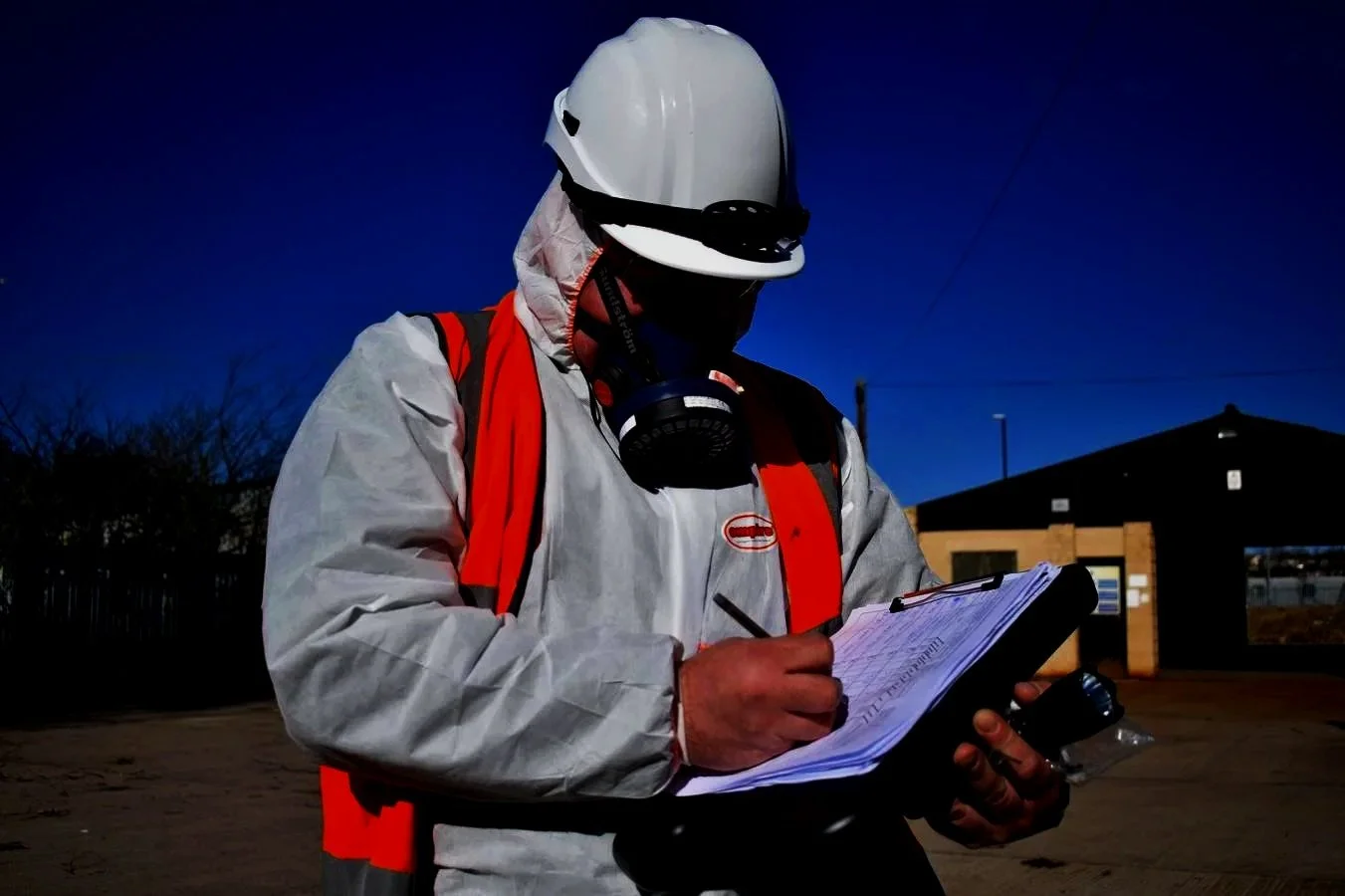
Asbestos Air Monitoring Berwick-upon-Tweed
Background, leak, personal, reassurance and clearance air monitoring for defined asbestos questions in Berwick-upon-Tweed. Four-stage clearance and Certificates for Reoccupation are provided where the full applicable process is required and satisfactorily completed.
Different air tests answer different project questions
Air monitoring should be selected from the decision the result needs to support rather than added automatically.
Background monitoring
Establish a reference airborne fibre concentration before relevant work where a baseline is justified by the project circumstances.
Leak monitoring
Assess defined positions outside a controlled enclosure while relevant asbestos work is being carried out.
Reassurance monitoring
Provide airborne fibre information after a defined disturbance, remedial activity or controlled cleaning where reassurance testing is appropriate.
Personal monitoring
Sample within a worker's breathing zone during a defined task to support exposure assessment and review of controls.
UKAS-accredited inspection and testing, with the scope kept clear
Asbestos Surveying and Monitoring Ltd holds UKAS accreditation number 32982 for defined inspection activities to ISO/IEC 17020 and testing activities to ISO/IEC 17025. The current schedules define the accredited activities and locations. Bulk asbestos identification is undertaken at the Sunderland laboratory.
Accreditation applies to the organisation and its defined activities. Asbestos removal, preparation of management plans, watching briefs and soil remediation are not described as UKAS-accredited work.
UKAS inspection schedule · UKAS testing schedule · Sunderland laboratory and submission guidance
Analytical attendance for Berwick projects
Occupied shops, schools and visitor premises
The monitoring objective should identify the work, nearby occupants, relevant locations and timing. Background, leak and reassurance samples are not interchangeable. Give the analyst the plan of work and site layout so sampling can be designed around the actual question, rather than simply asking for an unspecified “air test”.
Clearance after licensed removal
Agree analyst attendance, access, electricity, expected enclosure readiness and who commissions the clearance before final cleaning. The client should independently source and appoint the clearance analyst, in line with HSE guidance. A programme allowance is needed if cleaning or other work must be corrected before the process can proceed.
Unexpected disturbance at home or work
Stop the activity and avoid spreading dust or debris. A low airborne fibre result cannot tell you that all material has been removed or reconstruct the exposure before sampling. Assessment of the source, affected surfaces and suitable remediation must inform the response; air monitoring may provide part of the evidence.
Four-stage clearance is more than an air test
Where formal four-stage clearance applies, the process is sequential. Each applicable stage must be satisfactory before the analyst progresses.
1. Preliminary check
Review site condition, job completeness, enclosure readiness, transit arrangements and supporting information.
2. Thorough visual
Inspect the enclosure and work area carefully for visible asbestos debris, dust, residue and incomplete cleaning.
3. Clearance air sampling
After the visual stage passes, undertake the prescribed disturbance and air-sampling procedure where applicable.
4. Final assessment
Assess the former enclosure area after dismantling before completing the handover and Certificate for Reoccupation process.
Below 0.010 f/ml — a clearance indicator, not “zero asbestos”
HSG248 requires applicable Stage 3 clearance air sampling to achieve an airborne fibre concentration below 0.010 fibres per millilitre using the prescribed method. The clearance indicator is a transient measure of cleanliness, not normal airborne fibre levels.
Stage 3 clearance indicator
<0.010 fibres/ml (f/ml). A satisfactory air result alone does not complete the four-stage clearance.
GB workplace control limit
0.1 fibres/ml averaged over four hours. This is a separate legal workplace exposure benchmark and is not a safe exposure level.
Define the monitoring question before the analyst arrives
Define the purpose
Confirm whether the requirement is background, leak, reassurance, personal, clearance or formal four-stage clearance.
Send project information
Provide the site address, asbestos material, plan of work, enclosure details, date, shift pattern and occupied or sensitive areas.
Agree the strategy
ASM confirms attendance, sampling locations, timing, analytical scope, reporting and communication arrangements.
Monitor and report
The analyst records conditions, collects air samples, analyses the filters using applicable controlled procedures and reports the outcome.
What the analytical evidence should explain
Confirm the deliverables when agreeing the commission, then review the information against the actual property or work scope.
- The purpose, location and timing of the monitoring.
- The sampling conditions and relevant method, results and limitations.
- The relationship between the monitoring and the work or incident being assessed.
- For formal clearance, the outcome of all applicable stages and the final reoccupation documentation; a fibre count alone is not the full process.
If a location, quantity or assumption is unclear, resolve it before the relevant maintenance or construction stage. Keep reports and completion evidence together so the next contractor can understand what was assessed, what changed and what still needs attention.
Information to send before we arrange attendance
Property and purpose
Provide the full address, approximate size, current use and the decision you need the service to support. Include separate structures or adjoining areas that are part of the project. Tell us if the building was constructed or altered before 2000 and share any earlier asbestos records.
Work scope and evidence
Send relevant reports, marked plans, photographs taken safely and a concise description of any planned disturbance. State what will be retained as well as removed. Photographs help with scope but cannot confirm whether a material contains asbestos.
Access and programme
Give the proposed dates, occupancy, keyholder, parking or loading constraints and any restrictions on opening the fabric. Confirm who arranges isolation, escorts and specialist access. Attendance, laboratory turnaround and reporting dates are agreed for the project, rather than assumed from an online guide.
Agree a project-specific quotation
The cost depends on the actual scope, available evidence, site access, reporting requirements and programme. Send the relevant survey, register, analytical records or investigation information before the commission is agreed. Identify which services are already appointed and who will authorise any additional work.
Agree the deliverables and exclusions in writing. Site support, repeat attendance, laboratory work, monitoring and follow-up reporting should be identifiable within the quotation so the client can compare equivalent proposals.
Berwick-upon-Tweed service area and ASM support
Contact ASM for projects in Berwick-upon-Tweed, Tweedmouth and Spittal, and to discuss attendance at surrounding locations such as Scremerston, East Ord, Norham, Haggerston, Belford and Wooler. For work across the border, provide the full Scottish site address so the scope and project arrangements can be confirmed. Attendance depends on scope, access, programme and availability.
Regional enquiries
Call 0330 433 9680 or the Newcastle office on 0191 464 7159. Newcastle office: Collingwood Buildings, 38 Collingwood Street, Newcastle upon Tyne, NE1 1JF. Berwick is a service area, not a separately advertised ASM office.
Sunderland laboratory
Bulk sample analysis is undertaken at ASM’s Sunderland headquarters laboratory: 9 Defender Court, Sunderland Enterprise Park, Sunderland, SR5 3PE. Call 0191 481 2231 and confirm submission arrangements before delivery. Local service coverage does not imply a local laboratory.
Wider project support
See Newcastle asbestos services, Edinburgh asbestos services or corporate asbestos support for projects extending beyond this area. General enquiries: info@asbestosSM.co.uk.
Related Berwick services and practical guidance
Asbestos removal
Planned asbestos removal for homes, businesses, managed property and building projects in Berwick-upon-Tweed.
Removal costs
Understand the factors behind an asbestos removal quotation for Berwick-upon-Tweed.
Refurbishment surveys
Intrusive asbestos investigation before kitchens, bathrooms, rewires, heating upgrades, shop fit-outs and other alterations in Berwick-upon-Tweed.
Asbestos in soils
Asbestos watching briefs, investigation and remediation support for groundworks and redevelopment in Berwick-upon-Tweed.
Further reading
Asbestos Air Monitoring Berwick-upon-Tweed FAQs
Which type of asbestos air monitoring do I need?
The choice depends on the question: background, leak, personal, reassurance and clearance monitoring address different conditions. Send the work or incident details so the analytical scope can be defined.
What are the four clearance stages?
Preliminary site and work-completeness checks, a thorough visual inspection, clearance air monitoring and the final assessment after enclosure dismantling.
What is the Stage 3 clearance indicator?
The applicable HSG248 clearance air monitoring result must be below 0.010 fibres per millilitre. A satisfactory air result alone does not complete the four-stage clearance process.
When is a Certificate for Reoccupation issued?
Only after satisfactory completion of all applicable stages of the formal clearance process.
Is an air test required after every removal task?
No. Analytical requirements depend on the material, assessed work category, method, enclosure arrangements and project circumstances.
Can reassurance monitoring prove there was no earlier exposure?
No. It provides evidence for the defined sampling positions, period and conditions. It cannot reconstruct an earlier exposure or replace assessment and control of the source and debris.
Who should appoint the clearance analyst?
HSE strongly recommends that the building owner or client independently sources and employs the analyst for site clearance certification.
Discuss your Berwick-upon-Tweed project with ASM
Send the postcode, property details, existing asbestos information, photographs and planned work. We will confirm the appropriate service, access requirements and written quotation.