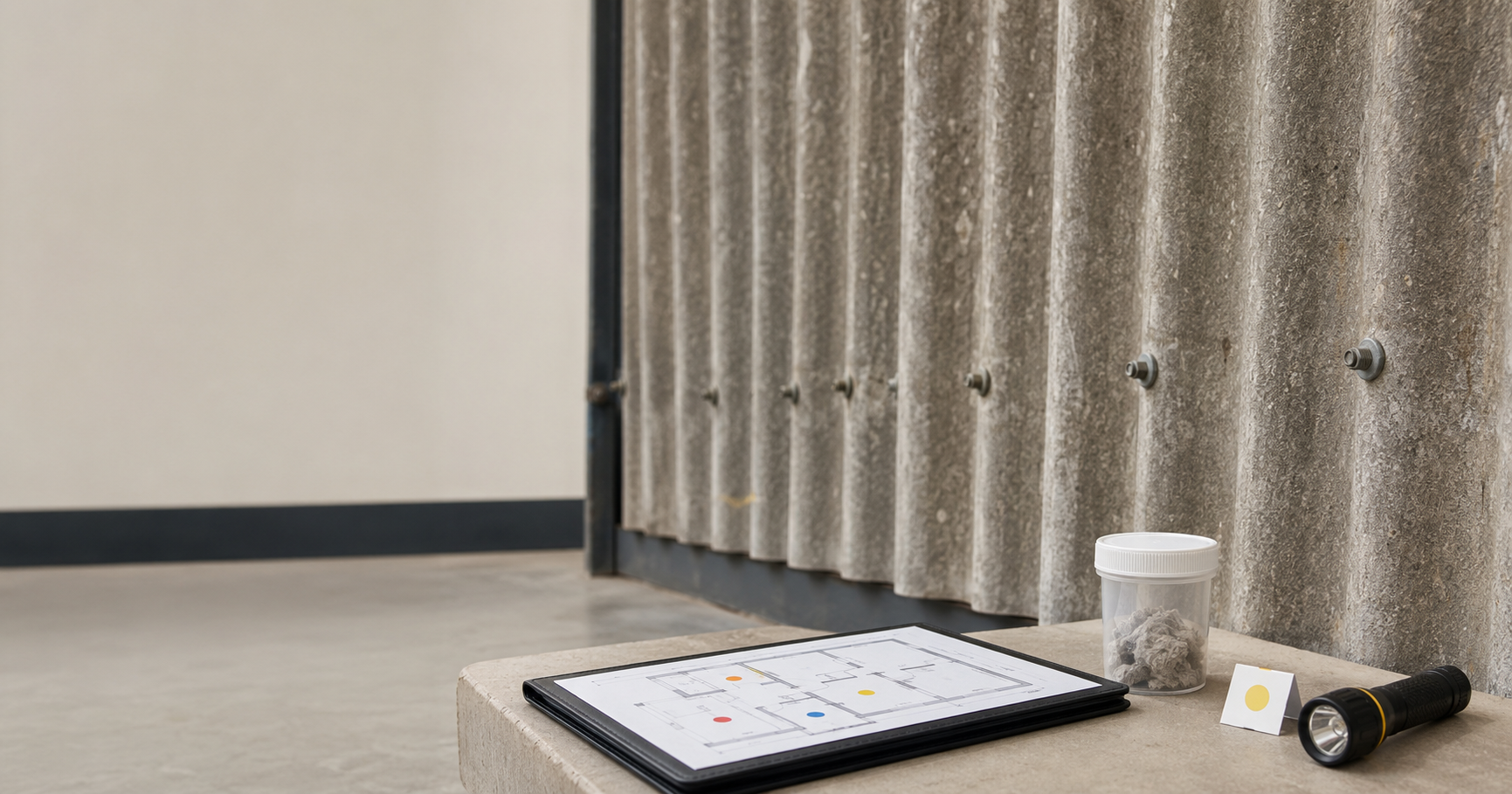
Finding asbestos in a survey does not automatically mean it must be removed. The next step is to understand the material’s condition, whether anyone could disturb it and how you intend to use or alter the building. Those answers determine whether it should be managed in place, repaired, protected or removed.
This guide explains how to turn an asbestos survey report into a practical action plan, from checking the recommendations to arranging further investigation, planning building work and keeping the right completion records.
Has the material already been disturbed? Stop work, keep people away from the affected area and tell the person responsible for the premises. Do not sweep up debris or use a domestic vacuum. Seek competent asbestos advice before anyone attempts a clean-up or restarts work. Read our accidental asbestos disturbance guide.
1. Check what the survey actually found
Start with the executive summary and recommendations, then check the individual material records, plans, photographs and laboratory results. An asbestos-containing material, often shortened to ACM, should be considered in its particular location and condition.
- Location and extent: identify the room, floor, surface or service involved. Match the record to its plan and sample reference.
- Confirmed or presumed asbestos: distinguish a positive laboratory result from a material being treated as asbestos because it has not been sampled or fully inspected.
- Condition and accessibility: look for damage, exposed edges, debris or a position where people could knock, drill or otherwise disturb it.
- Recommended action: check the proposed controls, priorities and any timescales. Ask the survey provider to explain unclear recommendations.
- Restrictions and exclusions: note locked rooms, concealed voids, live equipment and other areas the survey did not access.
A material assessment score is only part of the picture. How a room is used, who enters it, maintenance tasks and proposed alterations also affect the likelihood of disturbance. A low score does not give permission to cut or drill the material.
An uninspected area is not an asbestos-free area. Resolve any restriction that affects your planned work before that work begins. Where identification of a defined suspect material is needed, professional asbestos sampling and laboratory analysis may help; a photograph cannot confirm whether it contains asbestos.
2. Decide whether to manage, repair or remove it
The appropriate response depends on the findings and the building’s use. HSE guidance explains that material in good condition, which is unlikely to be disturbed, can often remain in place under suitable management.
| Situation | Possible next step | What needs to be agreed |
|---|---|---|
| Good condition and unlikely to be disturbed | Manage in place. | Record the material, prevent disturbance, inform relevant people and arrange condition checks. |
| Local damage that can be controlled | Consider competent repair, sealing or protective enclosure. | Confirm that the proposed treatment is suitable and include the retained material in ongoing management. |
| Material cannot be adequately protected, or planned work will disturb it | Assess the need for removal before the affected work proceeds. | Define the removal scope, work category, access controls, waste arrangements and completion requirements. |
| Survey gaps overlap the proposed work | Arrange further investigation. | Agree the exact work area and intrusive access needed; retain the asbestos presumption until resolved. |
These are decision routes, not instructions to undertake asbestos work yourself. Read HSE’s guidance on choosing and recording management actions.
3. Check the survey covers your planned building work
A management asbestos survey supports normal occupation and foreseeable maintenance. It does not automatically cover everything hidden behind walls, beneath floors or above ceilings that a refurbishment could disturb.
If you are planning a kitchen replacement, rewire, ceiling alteration, fit-out or other intrusive work, the scope of a refurbishment asbestos survey should match those activities. Full or partial demolition requires an appropriately scoped demolition asbestos survey.
Share drawings, the contractor’s work description and all proposed access routes with the survey provider. Include service penetrations, temporary works and soft strip areas. A negative result from one sample does not clear other materials or inaccessible parts of the building.
Example: an office survey may identify an intact panel that can remain during everyday occupation. If a later fit-out requires cutting through that panel or opening the void behind it, the original management recommendation must be reconsidered against the new work scope.
4. Put retained asbestos into an active management plan
The duty to manage asbestos applies to non-domestic premises and the common parts of multi-occupancy domestic buildings. Responsibilities depend on who controls maintenance and repair. The same duty does not generally apply inside a private home, although asbestos risks still need to be addressed when work is commissioned.
Where the duty applies, an asbestos management plan should identify the responsible person, maintain the register, set condition-check arrangements and explain how workers will receive asbestos information before starting a task.
HSE says the plan should be reviewed every 12 months, or sooner when necessary. Changes to the building, material condition, responsible staff or planned work can require an earlier review. Condition-check intervals should reflect the risk; this is not a universal annual expiry date for every survey.
An asbestos re-inspection survey can update the condition of known or presumed materials. It does not automatically resolve concealed areas or provide the intrusive investigation needed for a new refurbishment. See HSE’s duty to manage overview.
5. Plan removal and clearance around the actual task
Confirm who should carry out the work
Asbestos work can be licensable, notifiable non-licensed or non-licensed. The category depends on the material, condition, task and likely exposure. The fibre type shown on a laboratory certificate does not decide the category by itself.
ASM undertakes appropriate non-licensed and notifiable non-licensed work. Licensable removal is delivered through Flowing Construction Services Ltd within F&I Group. Our asbestos removal service page explains the delivery routes. The quotation should identify the responsible contractor and the agreed scope.
Before work starts, confirm access restrictions, protection of occupied areas, the programme, any notification requirements, waste arrangements and what evidence will be provided at completion.
Agree the clearance requirements before removal starts
Where four-stage clearance is required following licensed removal, the process includes:
- A preliminary check of the site condition and job completeness.
- A thorough visual inspection inside the enclosure or work area.
- Clearance air monitoring.
- A final assessment after the enclosure or work area has been dismantled.
Successful completion is documented in a Certificate for Reoccupation. This process applies to the defined work area; it is not a declaration that the whole property contains no asbestos. Four-stage clearance is not required after every asbestos removal task.
HSE strongly recommends that the building owner or client independently appoints the clearance analyst. Learn about asbestos air monitoring and clearance services or read our four-stage clearance guide. A reassurance air test does not replace a survey or prove that hidden materials are asbestos-free.
6. Budget for the specific next step
The cost depends on what remains to be established and what work is needed. A positive sample does not, by itself, provide enough information to price a removal project.
| Possible next instruction | Guide price | Important qualification |
|---|---|---|
| Targeted professional sampling | £80–£200 + VAT | For a defined suspect material; not a substitute for a wider survey where one is needed. |
| Refurbishment asbestos survey | Usually from £280 + VAT | Depends on the work area, intrusive access and sampling requirements. |
| Re-inspection | Fixed quotation | Based on the existing register, materials, access and reporting scope. |
These are guide figures, not automatic quotations. Check our current asbestos survey prices and removal cost guide. For removal, ask whether access equipment, enclosure, waste, analytical attendance and reinstatement are included. Confirm the scope and final price in writing.
7. Update the records before handing the area back
Keep the original survey alongside the evidence of what happened next. The register should distinguish removed material, retained asbestos and areas that remain uninspected.
- Record completed actions, dates and the relevant material or room references.
- Retain contractor completion information, applicable waste documentation and any analytical or clearance certificates.
- Update plans and condition records after repair, encapsulation or removal.
- Give the revised information to the people managing the premises and any follow-on contractors.
- Agree the next review or condition check for material left in place.
Our commercial premises asbestos handover checklist explains how to assemble a useful record for owners, occupiers and project teams.
Common questions after asbestos is found
Does every asbestos-containing material have to be removed?
No. Material in good condition that is unlikely to be disturbed can often be managed in place. Damage, accessibility, building use and planned work determine whether repair, protection or removal is appropriate.
Do I need to leave the building immediately?
A positive survey result alone does not establish that the whole building must be evacuated. If material has been disturbed or contamination is suspected, stop the affected work, restrict access and obtain competent advice on the necessary controls.
Can builders continue after asbestos is found?
Work that could disturb the identified or presumed material should not proceed until the risks have been assessed and suitable controls are in place. Whether work elsewhere can continue depends on the site arrangements and whether those activities could affect the asbestos.
Does a management survey cover refurbishment?
Not automatically. A management survey supports normal occupation and foreseeable maintenance. Intrusive refurbishment work needs survey information that covers the actual work area, including concealed materials that could be disturbed.
How often should the asbestos management plan be reviewed?
HSE says to review the plan every 12 months or sooner if necessary. Material condition, changes to the building, incidents or planned work may require an earlier review. Set material condition-check intervals according to the risk.
Is an air test enough to show the building is asbestos-free?
No. Air monitoring assesses airborne fibre concentrations under the conditions of the test. It does not identify every asbestos-containing material or replace an appropriate survey. Any clearance documentation relates to its defined scope and work area.
Need help deciding what your survey means?
Send ASM the complete report, property postcode and a description of any planned work. Include the proposed start date and relevant drawings so the findings can be considered against the project.
Asbestos Surveying and Monitoring Ltd supports customers across England, Scotland and Wales. ASM holds UKAS accreditation number 32982 for defined inspection and testing activities; accreditation does not cover asbestos removal.
Discuss your survey findings Call 0330 433 9680
Email your report to info@asbestosSM.co.uk.