

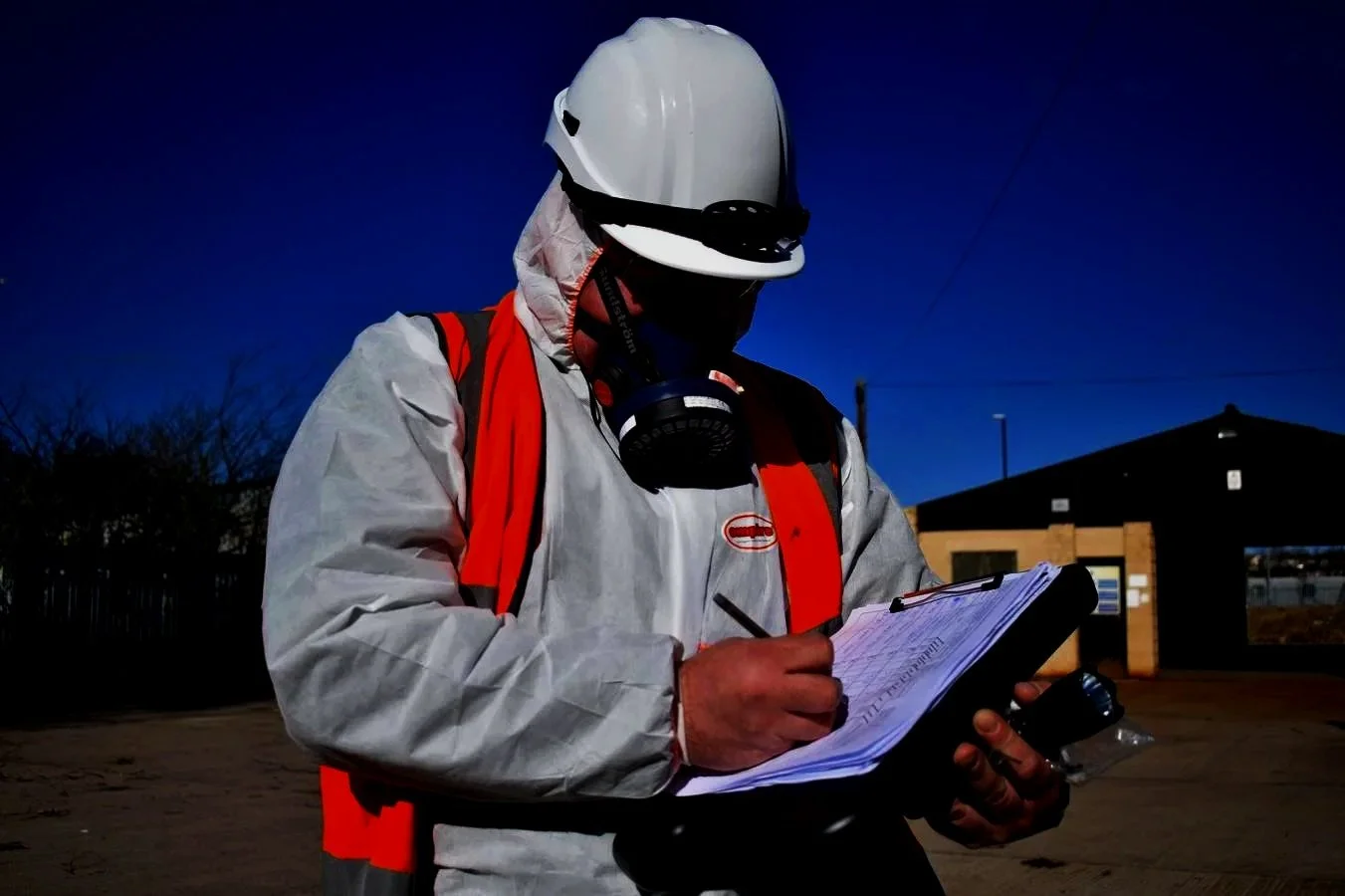
Asbestos air monitoring and four-stage clearance in Preston
Asbestos air monitoring and clearance enquiries for Preston work areas and property projects. Explain the purpose, location, conditions and decision the result must support. Monitoring does not replace material investigation, and formal clearance requires the applicable process with an independent client analytical appointment.
Stop the activity, keep people away where reasonably practicable and avoid sweeping or using a domestic vacuum. An air test does not replace immediate control of the source, debris and affected area.
Different air tests answer different project questions
Air monitoring should be selected from the decision the result needs to support rather than added automatically.
Background monitoring
Establish a reference airborne fibre concentration before relevant work where a baseline is justified by the project circumstances.
Leak monitoring
Assess defined positions outside a controlled enclosure while relevant asbestos work is being carried out.
Reassurance monitoring
Provide airborne fibre information after a defined disturbance, remedial activity or controlled cleaning where reassurance testing is appropriate.
Personal monitoring
Sample within a worker's breathing zone during a defined task to support exposure assessment and review of controls.
Four-stage clearance is more than an air test
Where required, a Certificate for Reoccupation follows satisfactory completion of all applicable stages. A failure or unresolved issue must be addressed; a single satisfactory air measurement cannot override incomplete cleaning or other failed clearance requirements.
See HSE’s analyst guide, HSG248 for the analytical framework.
1. Preliminary check
Review site condition, job completeness, enclosure readiness, transit arrangements and supporting information.
2. Thorough visual
Inspect the enclosure and work area carefully for visible asbestos debris, dust, residue and incomplete cleaning.
3. Clearance air sampling
After the visual stage passes, undertake the prescribed disturbance and air-sampling procedure where applicable.
4. Final assessment
Assess the former enclosure area after dismantling before completing the handover and Certificate for Reoccupation process.
Below 0.010 f/ml — a clearance indicator, not “zero asbestos”
HSG248 requires applicable Stage 3 clearance air sampling to achieve an airborne fibre concentration below 0.010 fibres per millilitre using the prescribed method. The clearance indicator is a transient measure of cleanliness, not normal airborne fibre levels.
Stage 3 clearance indicator
<0.010 fibres/ml (f/ml). A satisfactory air result alone does not complete the four-stage clearance.
GB workplace control limit
0.1 fibres/ml averaged over four hours. This is a separate legal workplace exposure benchmark and is not a safe exposure level.
Define the monitoring question before the analyst arrives
A landlord, removal client or contractor may need different evidence from air monitoring. Explain the work history, material, current activity and decision required. The analytical organisation can then agree the appropriate purpose, method and assessment boundaries.
Identify the actual suite, floor or enclosure and neighbouring occupation, particularly for a phased fit-out or mixed-use building. Keep records tied to those locations. An earlier result should not become a general assurance for other rooms, later activities or concealed materials.
Where formal clearance applies, arrange the full applicable process through an independent client appointment. Confirm the current accredited scope, site-readiness responsibilities and reporting route. Attendance can be coordinated with removal while preserving independent assessment and the possibility that further work is required.
Define the purpose
Confirm whether the requirement is background, leak, reassurance, personal, clearance or formal four-stage clearance.
Send project information
Provide the site address, asbestos material, plan of work, enclosure details, date, shift pattern and occupied or sensitive areas.
Agree the strategy
ASM confirms attendance, sampling locations, timing, analytical scope, reporting and communication arrangements.
Monitor and report
The analyst records conditions, collects air samples, analyses the filters using applicable controlled procedures and reports the outcome.
Preston analytical evidence for phased occupation
One phase is ready and another remains in work
Use clear floor, suite or enclosure references when arranging monitoring and handover. The analyst needs the actual boundaries and adjacent activity. A satisfactory assessment for one defined area should not be used as a general release for other phases.
Agree who receives the records and who controls access to the released area. Keep the analytical purpose and the site manager’s wider operational decisions distinct.
A landlord needs evidence before reletting
Explain what work has occurred, the material involved and the question that the evidence must answer. An air test alone does not reconstruct the previous removal method or identify hidden material. Provide the survey, work and cleaning records needed for competent assessment.
Where formal clearance is applicable, book the full process through an independent client appointment. Confirm readiness before attendance and allow for further cleaning or investigation if required.
A concern in residential common parts
Explain the event, suspected source, affected area and any controls already taken in the Preston property. Agree the question for monitoring and record the conditions: the results cannot establish earlier exposure or replace investigation of the source.
UKAS 32982: defined inspection and testing activities
Asbestos Surveying and Monitoring Ltd holds UKAS accreditation number 32982 for defined inspection activities to ISO/IEC 17020 and testing activities to ISO/IEC 17025. The current schedules define the applicable activities and locations. Bulk material identification is undertaken at the Sunderland laboratory.
Sunderland laboratory and testing information
Removal, management-plan preparation, watching briefs and remediation are separate services and are not described as UKAS accredited.
Appoint the analyst with clear independence
Where formal site clearance certification applies, HSE advises the building owner or client to independently source and employ the analyst. The analyst’s appointment and reporting should be clear even where the removal programme is coordinated with other contractors.
Provide the removal plan, relevant survey, location and scope, proposed enclosure arrangements, programme and required evidence. Agree when the site will be ready, who provides access and how any failed stage or reattendance will be managed.
Read HSE guidance on putting the management plan into action.
Preston analytical records and phased handovers
Agree the recipient and intended use of each report. The client, facilities manager and refurbishment contractor may need the evidence at different stages, but the report must remain connected to the same assessed work area and conditions.
Where a project releases individual floors or units in phases, identify each boundary consistently across the work plan, analytical record and handover. Do not extend a result from one completed zone to a later phase that has not undergone the required process.
If the layout, containment or programme changes, tell the analytical organisation before attendance. It may need to review the instruction, access or method. Avoid treating a booking as fixed evidence that the site will be ready on that date.
For formal clearance, confirm the appropriate readiness and inspection process with the responsible parties. A following contractor’s deadline should not determine whether the required assessment is complete or how its outcome is reported.
Keep reports with the removal and management records, including remaining material and limitations. For a Preston portfolio, retain separate property and work-area references so an analytical result is not reused for another address or a different activity.
Plan analytical attendance around readiness and the work conditions
The analyst needs a site that is ready for the commissioned task. For formal clearance, communicate the work boundary, relevant plan of work, progress and any changes before the booked attendance. Make sure the people responsible for site access and preparation understand that a programme date does not establish successful completion.
For monitoring during a Preston industrial activity, specify the operation and conditions the sampling should assess. The sampling location, duration and work occurring at the time matter to interpretation. A measurement cannot be assumed to represent different activities, locations or later conditions without a suitable basis.
Agree reporting recipients and any immediate escalation needed if a stage fails or conditions differ from the brief. The client, removal contractor and analyst should understand who addresses outstanding issues, who requests repeat attendance and how the release of the work area is controlled.
Keep the analytical evidence with the removal or project records. Where a material-identification question remains, commission the appropriate bulk investigation rather than relying on air results to answer it.
What the analytical record should explain
- The client, site and defined purpose of the instruction.
- The sampling locations, timing and relevant work or site conditions.
- The applicable method, result and limitations.
- The clearance stages and outcome where formal clearance applies.
- Outstanding issues or repeat work required before handback.
- Who receives and retains the records for the project.
Use the removal service for planning connected work and bulk testing when the question concerns material identification.
Use the actual suite, floor, enclosure or phase identity in the instruction and retained records. A landlord may manage several similar units, but evidence from one area is not a general statement about the estate. Keep the plan and location references with the report.
Background, personal, leak and reassurance monitoring address different questions. Formal clearance adds its applicable site-assessment stages. The client should describe the decision required and allow the analytical organisation to specify the suitable process, rather than choosing a test by its name alone.
Agree who confirms that removal and preparation have reached the required stage before attendance. Further cleaning or investigation can be necessary. The analyst’s independent assessment must not be reduced to a timetable commitment because a tenant expects to move in or another contractor is booked.
Retain the relevant survey, removal and updated register information with analytical documentation. A satisfactory result applies to the assessed purpose and conditions; it does not identify every hidden material or replace the information needed before later intrusive work. Explain any retained materials to those managing the premises.
Preston service coverage and enquiries
ASM · Preston service enquiries
Site attendance by prior arrangement. Send the property address, required service and target dates.
National enquiries
0330 433 9680
Monday–Friday · 08:00–18:00
Preston analytical attendance
Preston city centre, Fulwood, Ashton-on-Ribble, Riversway, Preston East, Deepdale, Ribbleton and the Winckley Square area.
Agree the monitoring objective, site readiness, enclosure arrangements and analyst attendance with the project team.
ASM supports Preston enquiries and surrounding Lancashire projects. Penwortham, Bamber Bridge, Walton-le-Dale and Walton Summit are neighbouring South Ribble locations; include the exact address so the service and attendance can be agreed.
For mixed-use property, identify individual flats, commercial suites and common parts. For a portfolio, retain separate address and access references even where one managing agent coordinates the programme.
Bulk material analysis is undertaken through ASM’s Sunderland laboratory. Confirm collection or sample-submission arrangements with the team before attendance or dispatch.
Preston services linked to analytical attendance
Asbestos Air Monitoring Preston FAQs
Which air-monitoring instruction suits a Preston landlord’s question?
Explain the material, work history, current conditions and decision required. Background, leak, personal, reassurance and clearance monitoring have different purposes. The analytical organisation should confirm a suitable instruction rather than treating every request as a generic air test.
Can one clearance document release several unrelated suites?
Only the areas and process covered by the assessment are addressed. Use clear suite, floor and enclosure references and retain the corresponding records. Separate work areas or later phases may need their own assessment.
What should a managing agent provide before analytical attendance?
Send relevant survey and removal information, plans, phase boundaries and access contacts. Explain adjacent occupation and the required handover. Confirm readiness with the analytical organisation before the appointment.
Does reassurance monitoring prove that hidden asbestos has been removed?
No. It assesses a defined airborne-fibre question under the conditions examined. Hidden material, source contamination and the adequacy of earlier removal require appropriate evidence and assessment. Do not use an isolated result as a whole-building certificate.
Can Preston residents remain in neighbouring accommodation during assessment?
Explain the occupation and boundaries to the competent organisations planning the work. Suitable arrangements depend on the actual task and conditions. Analytical attendance should not be used to assume that every occupation arrangement is acceptable.
What are the main stages of formal four-stage clearance?
The applicable process addresses preliminary checks, a thorough visual inspection, clearance air monitoring and final assessment after enclosure dismantling. A satisfactory outcome requires the relevant stages, not simply a fibre count from one air sample.
What happens if the area is not ready when the analyst arrives?
The process may be delayed or require further cleaning or preparation. Agree readiness responsibilities and the effect on the programme in advance. A booked appointment cannot guarantee a satisfactory result or immediate handover.
How should the client maintain analytical independence?
Where formal clearance is required, independently source and employ the analytical organisation and agree reporting arrangements. Coordination with removal is necessary, but the analyst’s assessment and decision must remain independent.
Can monitoring from the first fit-out phase be reused for the next?
Not automatically. Results relate to the purpose, locations, activity and conditions assessed. A changed phase or work area needs review by the analytical organisation before earlier evidence is relied upon.
Is personal monitoring the same as reassurance monitoring?
No. Personal monitoring addresses exposure during a defined activity, while reassurance monitoring addresses a different site question. State the required decision so the appropriate method, locations and interpretation can be agreed.
What should a new tenant receive following applicable clearance?
The relevant analytical records for the actual area, alongside removal and updated asbestos information. The tenant should understand any retained materials and limitations rather than relying only on a brief statement that an air test passed.
Can an air test decide whether flooring contains asbestos?
No. Identification of flooring requires appropriate bulk-material investigation and analysis. Air monitoring does not replace that evidence or the survey needed before intrusive refurbishment. Contact ASM to select the correct service.
Define what the air test needs to answer
Send the Preston site address, asbestos material, removal or incident details, plan of work where applicable, enclosure information, monitoring objective, date and shift requirements. ASM can confirm the analytical scope and attendance availability.