

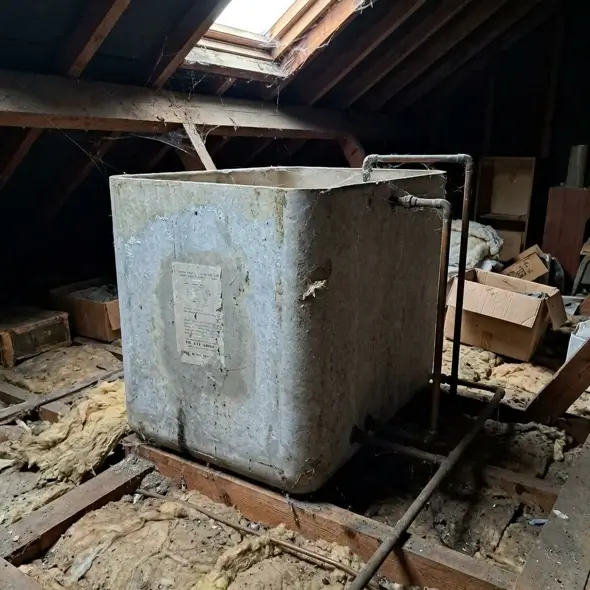
Asbestos Water Tank & Cistern Removal UK
Controlled removal and disposal of asbestos-cement cold-water tanks and asbestos-containing toilet cisterns from homes, commercial buildings, loft spaces and refurbishment projects throughout England, Scotland and Wales.
How much does asbestos water tank or cistern removal cost?
Straightforward intact units can normally be priced by item. Access, condition, plumbing, unit size and whether the product can be removed without significant break-up determine the final quotation.
Asbestos cement water tank removal
From £320 + VAT per tankFor a straightforward single asbestos-cement water tank with suitable access and condition, allowing controlled removal and disposal.
Asbestos-containing cistern removal
From £180 + VAT per cisternFor a straightforward accessible asbestos-containing cistern where the unit can be safely removed without unnecessary break-up.
What do these starting prices assume?
The £320 tank and £180 cistern figures are starting prices for suitable individual items with straightforward access and condition. Final pricing is confirmed after photographs, asbestos information and access details have been reviewed.
Where are asbestos water tanks and cisterns found?
Moulded asbestos-containing products were widely used in older UK properties because they were durable and resistant to moisture, corrosion and heat.
How do I know whether a tank or cistern contains asbestos?
Appearance can suggest that a product may be asbestos-containing, but appearance alone should not be treated as laboratory confirmation.
Asbestos cement tanks
Older asbestos-cement water tanks are normally rigid moulded units with a cement-like grey surface. They may be square or rectangular and are frequently located on timber bearers within loft spaces.
- Hard cement-type material
- Grey or painted finish
- Thick moulded walls
- Older cold-water storage system
- Often located within lofts
Asbestos-containing cisterns
Some older toilet cisterns and similar moulded products were manufactured from asbestos-reinforced plastic or resin products rather than conventional asbestos cement.
- Older moulded cistern
- Hard resin / plastic appearance
- Often heavily painted
- Historic manufacturer markings may remain
- Appearance alone is not definitive
Do not break a tank to see what it is made from
If asbestos information is unavailable, use suitable survey or sampling evidence rather than drilling, snapping, scraping or breaking the product to investigate it.
Arrange asbestos sampling or view asbestos survey services .
Is asbestos water tank removal licensed work?
Removal of a suitable asbestos-cement tank or asbestos-reinforced cistern can normally be undertaken as non-licensed asbestos work where the product remains sufficiently intact and the correct controls are used.
| Situation | Typical work position | ASM approach |
|---|---|---|
| Intact asbestos-cement water tank | Normally suitable for controlled non-licensed removal. | Plan removal to minimise breakage and fibre release. |
| Intact reinforced cistern | HSE A15 includes asbestos-reinforced plastic products such as cisterns within its non-licensed task guidance. | Controlled whole-item removal where practicable. |
| Weathered but substantially intact cement tank | Condition assessed before confirming the work category. | Additional surface protection and handling controls may be required. |
| Badly damaged asbestos cement | Significant damage can alter the work to NNLW. | Work category reviewed before removal starts. |
| Significant break-up required | Deliberate substantial break-up can alter classification and exposure controls. | Not treated as the standard £320 / £180 removal scope. |
| Product attached to AIB or higher-risk ACM | The surrounding asbestos material may determine the work category. | Higher-risk removal route assessed separately. |
Does an asbestos water tank always need removing?
No. A redundant asbestos-containing tank that remains in good condition and does not interfere with building use can sometimes remain managed in place.
What is included in the £320 tank and £180 cistern guide?
Typical standard removal scope
- Review of asbestos information
- Project-specific risk assessment / RAMS
- Controlled work area
- Appropriate PPE/RPE
- Careful ACM handling
- Controlled removal
- Asbestos wrapping / packaging
- Cleaning of the work area
- Asbestos waste disposal
- Completion / waste documentation
Usually priced separately
- Major plumbing isolation or alteration
- Replacement water tank
- Replacement toilet cistern
- Loft hatch enlargement
- Carpentry / structural alterations
- Scaffold or specialist access
- Extensive loft boarding
- Multiple tanks or cisterns
- Damaged surrounding ACMs
- Making good / decoration
Factors that can change the final quotation
What should you send ASM?
Straightforward domestic tanks and cisterns can often be assessed from suitable photographs and asbestos information without an additional pricing visit.
How asbestos water tanks are removed
The exact RAMS is project-specific. The sequence below is a high-level overview rather than DIY removal instructions.
Review asbestos information, condition, dimensions, access, plumbing status and surrounding materials.
Establish safe access and protect surrounding surfaces from contamination before work begins.
Remove the unit using the planned low-disturbance method while avoiding unnecessary damage or fibre release.
Package the ACM correctly, clean the affected work area and manage the waste through the authorised asbestos route.
Do not break an asbestos tank simply to get it through a loft hatch
Access should be assessed before removal. If a unit cannot be removed using the straightforward planned method, ASM will determine the appropriate alternative scope and work category before proceeding.
Is an asbestos air test required after removing a water tank?
For straightforward controlled removal of a suitable asbestos-cement tank or cistern, clearance air sampling is not normally automatically required.
HSE A15 instead requires the area to be properly cleaned and visually checked. Air monitoring may be appropriate where the circumstances, material condition, contamination or wider project risk justify it.
One coordinated asbestos-removal route
ASM directly undertakes appropriate non-licensed and notifiable non-licensed asbestos work.
If the project contains other higher-risk asbestos materials requiring an HSE licence, licensed work can be delivered within F&I Group through Flowing Construction Services Ltd under asbestos licence 202505985.
ASM & F&I GroupWider project support
- Asbestos surveying
- Asbestos sampling
- Tank and cistern removal
- Asbestos cement removal
- Flue and duct removal
- Pipe-lagging removal
- Air monitoring where appropriate
- Access and scaffolding
- Soft-strip works
- Wider construction interfaces
UKAS-accredited asbestos inspection and testing capability
Where existing asbestos information is inadequate, ASM can provide appropriate inspection or sampling support before the removal work is confirmed.
ASM holds UKAS accreditation number 32982 for defined asbestos inspection and testing activities within its current accredited schedules.
Asbestos removal itself is not UKAS accredited
UKAS accreditation applies to defined inspection and testing activities. Removal of an asbestos-containing water tank or cistern is a separate work activity.
Continue from tanks and cisterns to the right service
Asbestos water tank and cistern removal FAQs
How much does an asbestos water tank cost to remove?
How much does an asbestos toilet cistern cost to remove?
What is included in the £320 water tank price?
Does £320 include installing a new water tank?
Does the £180 cistern price include a new toilet cistern?
Is an asbestos cement water tank licensed work?
What is HSE Asbestos Essentials A15?
What if the asbestos tank is damaged?
Can an asbestos water tank be left in a loft?
Can the tank be broken up to get it through the loft hatch?
Does the water need to be disconnected first?
Do I need an air test after asbestos water tank removal?
How do I know if my old water tank contains asbestos?
Can ASM remove several asbestos cisterns from one building?
What should I send for a quick quotation?
Official guidance relevant to water tanks and cisterns
Get your asbestos water tank or cistern removal priced
Send ASM the asbestos survey or laboratory result, photographs, approximate dimensions, property postcode, access details and confirmation of whether the tank or cistern remains connected. We can then confirm whether the standard removal route is appropriate and provide a written project quotation.