

Asbestos Insulating Board (AIB) Removal UK
Specialist removal of asbestos insulating board from ceilings, partitions, firebreaks, service risers, soffits, boiler enclosures and other building locations. Most substantive AIB removal requires an HSE-licensed asbestos contractor and a project-specific site assessment, plan of work and controlled removal setup.
AIB removal needs more planning than asbestos cement or floor tiles
Asbestos insulating board, normally abbreviated to AIB, was widely used for fire protection, thermal insulation, acoustic performance and internal building construction. Compared with heavily bonded asbestos cement, AIB is more readily damaged and can release significantly more asbestos fibres when cut, broken or disturbed.
HSE identifies most AIB removal as higher-risk work requiring an asbestos contractor holding the appropriate licence.
ASM therefore does not treat substantive AIB removal as a simple online square-metre quotation. The size, condition and fixing of the boards must be considered alongside the enclosure, access, site occupation, decontamination arrangements, waste route and analytical requirements before the final work scope is priced.
Licensed removal works are delivered within F&I Group through Flowing Construction Services under asbestos-removal licence 202505985, with ASM providing the wider surveying, technical and analytical capability as appropriate to the project.
How much does AIB removal cost?
ASM uses £140–£350+/m² + VAT as an initial budgeting range for substantive AIB removal, but the square-metre rate alone is not sufficient to price the project accurately.
Depending on the size of the removal area and the complexity of the licensed asbestos-removal setup.
Highly complex, restricted, phased or small licensed projects can exceed the upper end of this guide.
Arrange a Site AssessmentWhy ASM does not issue a final AIB price from area alone
The actual asbestos area may be only one part of the overall cost. A relatively small quantity of AIB can require extensive preparation if the enclosure is difficult to construct or the site remains occupied.
The quotation can need to account for:
- licensed asbestos-removal labour;
- enclosure construction;
- negative-pressure equipment;
- decontamination-unit arrangements;
- HSE/enforcing-authority notification;
- access and scaffolding;
- electrical and mechanical isolation;
- asbestos waste handling;
- analytical attendance;
- four-stage clearance where applicable;
- multiple work areas or phases;
- reinstatement and other construction interfaces.
£140–£350+/m² is a budgeting range — not an automatic quotation
ASM requires an individual assessment of each substantive AIB removal project before issuing the final fixed price. The visit allows the removal scope and site setup to be assessed against the actual building rather than making assumptions from floor area alone.
For detailed pricing factors see Asbestos Insulating Board Removal Cost UK .
Where is asbestos insulating board found?
AIB was used extensively throughout UK buildings because it provided useful fire, thermal and acoustic properties.
Common locations include:
- ceiling tiles;
- suspended ceilings;
- internal partition walls;
- wall linings;
- bulkheads;
- firebreaks above ceilings;
- service risers;
- lift shaft linings;
- airing cupboards;
- panels around boilers and heating equipment;
- fire-door panels;
- window panels;
- external soffits;
- column and beam protection.
AIB can closely resemble ordinary non-asbestos building board. Appearance alone should therefore not be used to identify it.
Where reliable asbestos information is unavailable, ASM can provide professional asbestos sampling or an appropriate asbestos survey .

A site assessment is required before the final AIB removal price
The HSE framework requires asbestos work to be properly assessed and planned. For substantive AIB removal, ASM's policy is therefore to assess the site before confirming the final fixed quotation.
This allows the proposed licensed-removal setup to be considered properly rather than basing the price solely on photographs or an assumed square-metre rate.
Does AIB removal require a licensed asbestos contractor?
Most substantive removal of asbestos insulating board requires an HSE-licensed asbestos contractor. Limited low-risk short-duration AIB tasks can fall outside licensing, but those exemptions are narrow and should not be assumed simply because the quantity of board is small.
| Example activity | Typical HSE position | ASM approach |
|---|---|---|
| AIB partition removal | Most removal of AIB partitions is licensable work. | Licensed-removal project with site assessment and project-specific plan of work. |
| Suspended AIB ceiling removal | Full removal of AIB ceiling tiles or suspended ceilings generally requires a licensed contractor. | Enclosure, access and analytical strategy assessed on site. |
| Damaged or deteriorated AIB | AIB in poor condition is higher risk and normally licensable. | Specialist assessment with controls based on contamination, debris and likely fibre release. |
| AIB firebreaks, riser panels and bulkheads | Significant removal is normally within the licensed-work category. | Access, enclosure and services assessed before quotation. |
| Single small panel | Certain tightly controlled short-duration tasks involving a single small AIB panel can potentially be non-licensed or NNLW where all HSE criteria are satisfied. | Individually assessed. ASM does not automatically classify a small AIB job as non-licensed. |
| Work likely to produce high fibre release | Licensed even where the duration is short. | Licensed route selected where the risk assessment indicates significant fibre release. |
Short duration does not automatically mean non-licensed
HSE's short-duration test for work with AIB limits the time any one worker spends on the work and the total combined person-hours. However, work that is likely to produce high asbestos-fibre release remains licensable even if those time limits could otherwise be met.
How substantial AIB removal is planned
Every plan of work is site-specific. A typical licensed AIB project may include the following stages depending on the building and removal scope.
Confirm the AIB location, extent, condition, fixing, access, adjoining areas, services and proposed refurbishment or demolition works.
Prepare the detailed plan of work, equipment requirements, enclosure strategy and licensed-work notification before the planned start date.
Construct and test the required enclosure, negative-pressure arrangements, access system, waste route and decontamination facilities.
Remove the AIB using the planned controlled method, complete asbestos cleaning and progress through the applicable analytical clearance and handover process.
How AIB fibre release is controlled
The objective is to prevent asbestos fibres escaping the controlled work area and to reduce operative exposure as low as reasonably practicable. The actual controls are determined in the project plan of work.
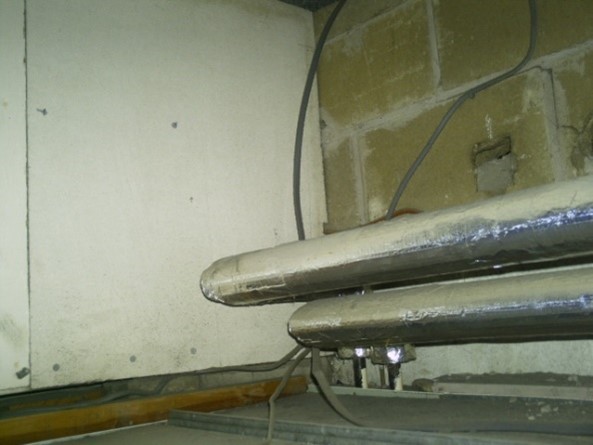
The visible area may not represent the full removal scope
AIB is frequently concealed behind ceilings, partitions and building finishes.
Firebreaks can continue through ceiling voids, bulkheads can conceal further boarding and service risers may contain panels at several floor levels.
This is another reason ASM does not rely on a simple square-metre calculation for the final quotation.
Before intrusive refurbishment or demolition, the asbestos survey needs to define the affected building fabric sufficiently for the removal contractor to prepare the plan of work.
Asbestos survey services →Allow for the licensed asbestos notification period
Licensable asbestos work must normally be notified to the appropriate enforcing authority at least 14 days before the work starts.
This means the start date for a substantial AIB removal project normally needs to be planned in advance rather than booked as an immediate next-day removal.
The removal contractor prepares the appropriate notification and detailed plan of work. A shorter notification period can apply only where the relevant circumstances and enforcing-authority arrangements permit it and should not be assumed for planned refurbishment work.
Clients should therefore allow sufficient time for:
- site assessment;
- survey-information review;
- quotation and instruction;
- detailed planning;
- licensable-work notification;
- enclosure and site setup;
- removal;
- cleaning and analytical clearance;
- reoccupation or handover.
Four-stage clearance after licensed AIB removal
Licensed asbestos-removal areas must be thoroughly cleaned before handover. Where formal clearance is required, the area progresses through the four-stage clearance process and Certificate for Reoccupation procedure in accordance with the applicable analytical requirements.
The analyst reviews the condition of the site, enclosure and supporting documentation before progressing.
The defined area is examined for remaining asbestos-containing material, dust and debris.
Air sampling is undertaken in accordance with the applicable analytical clearance procedure.
Following satisfactory dismantling of the enclosure, the final stage is completed and the appropriate Certificate for Reoccupation issued.
Read more about ASM asbestos air monitoring and four-stage clearance .
What moves AIB removal toward £140 or £350+/m²?
Survey, removal, analytical support and reinstatement
Licensed AIB removal is delivered within F&I Group through Flowing Construction Services under asbestos-removal licence number 202505985.
ASM provides asbestos surveying, bulk analysis and analytical services within the relevant accredited scopes, allowing the wider project to be coordinated around the actual asbestos and construction requirements.
Wider project requirements can include
- Refurbishment and demolition surveys
- Targeted intrusive inspection
- Bulk asbestos analysis
- Licensed AIB removal
- Asbestos waste management
- Air monitoring
- Four-stage clearance where applicable
- Scaffolding and specialist access
- Soft-strip works
- Roofing and building-envelope works
- Fire-protection interfaces
- Reinstatement coordination
UKAS accreditation supporting AIB projects
Asbestos Surveying and Monitoring Ltd holds UKAS accreditation number 32982 for defined asbestos inspection and testing activities within its current schedules.
Depending on the project and appropriate appointment arrangements, these services can support AIB projects through identification, surveying, bulk analysis and relevant air-monitoring or clearance activities.
UKAS accreditation does not apply to asbestos removal itself
The licensed removal activity and the UKAS-accredited analytical or inspection activities are distinct functions. UKAS accreditation should only be described against the activities included within ASM's current accredited scope.
AIB removal, surveys and asbestos cost guidance
Asbestos insulating board removal FAQs
How much does AIB removal cost per square metre?
Why does ASM need to assess the site before pricing AIB removal?
Does all AIB removal require a licensed asbestos contractor?
What does short-duration AIB work mean?
Does licensed AIB removal have to be notified?
Does AIB removal need an enclosure?
What is an asbestos decontamination unit?
Does AIB removal require four-stage clearance?
Can AIB be removed intact?
What if the AIB is already damaged?
Where is AIB commonly found?
Can you tell AIB from plasterboard by looking at it?
Can ASM undertake both the survey and the removal project?
What information should I provide before the site assessment?
Guidance relevant to AIB removal
AIB work should be classified from the actual task, condition, duration and likely fibre release rather than assuming that all board products can be handled in the same way.
Arrange an AIB removal site assessment
Send ASM your asbestos survey, photographs and approximate removal area. We will review the available information and arrange an individual assessment of the AIB, access, enclosure requirements, DCU position, waste route, analytical requirements and wider site constraints before the final removal quotation is confirmed.