

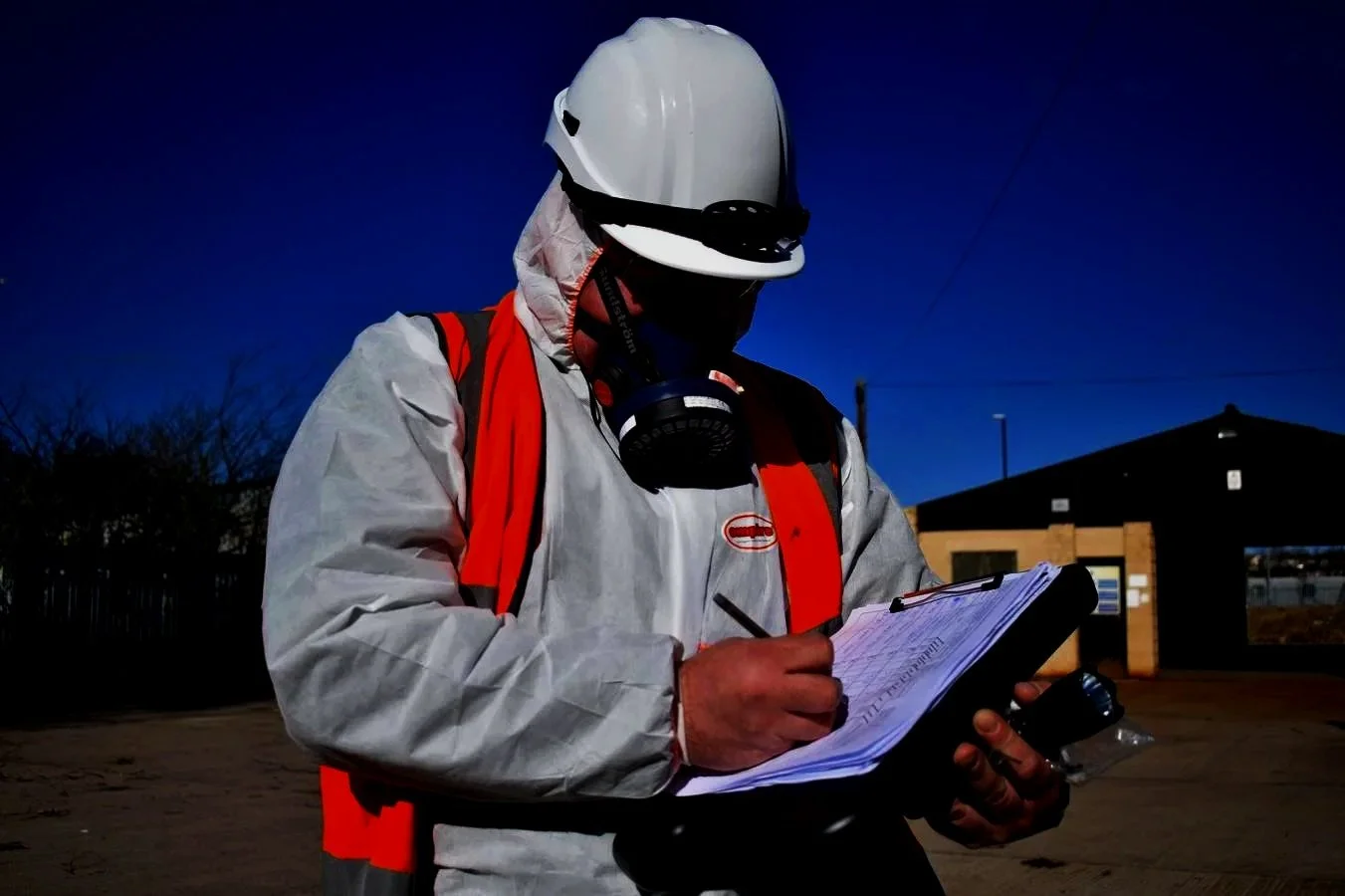
Asbestos air monitoring and four-stage clearance in Birmingham
Background, leak, reassurance, personal and clearance air monitoring across Birmingham and the West Midlands, together with four-stage clearance and Certificates for Reoccupation where the complete process is applicable and satisfactorily passed.
Stop the activity, restrict access where reasonably practicable and do not sweep or use a domestic vacuum. Air monitoring does not replace source assessment, cleaning or material identification where those actions are still required.
Different air tests answer different project questions
Air sampling should be selected from the decision the result needs to support. One test cannot answer every exposure, enclosure, reassurance or reoccupation question.
Background monitoring
Establish a reference airborne fibre concentration before relevant removal, disturbance or remediation where a baseline is justified.
Leak monitoring
Assess defined locations outside an enclosure during relevant asbestos work as part of the agreed analytical strategy.
Reassurance monitoring
Provide airborne fibre information after a defined disturbance, controlled task or cleaning activity where reassurance testing is appropriate.
Personal monitoring
Sample within a worker's breathing zone during a defined task to support exposure assessment and review of controls.
Formal clearance is more than an air test
The applicable process is sequential. A stage must be satisfactory before the analyst progresses to the next.
1. Preliminary check
Review site condition, job completeness, enclosure readiness, transit and waste arrangements and supporting information.
2. Thorough visual
Inspect the enclosure and work area carefully for visible asbestos debris, dust, residue and incomplete cleaning.
3. Clearance air monitoring
After the visual stage passes, undertake the prescribed disturbance and air-sampling procedure where applicable.
4. Final assessment
Assess the former enclosure area after dismantling before completing the handover process.
Below 0.010 f/ml — a clearance indicator, not “zero asbestos”
HSG248 states that Stage 3 clearance air sampling must achieve an airborne fibre concentration below 0.010 fibres per millilitre using the prescribed method. This is a transient clearance indicator and is distinct from the GB workplace control limit.
Clearance indicator
<0.010 fibres/ml (f/ml) for applicable Stage 3 clearance air sampling. A satisfactory result alone does not complete the four-stage process.
GB control limit
0.1 fibres/ml over four hours. This is a different legal workplace exposure limit and should not be confused with the Stage 3 clearance indicator.
Plan analytical attendance before the project reaches handover
Define the question
Confirm whether the requirement is background, leak, reassurance, personal, clearance or full four-stage clearance.
Provide project information
Send the site address, material, plan of work, enclosure details, dates, shift pattern and occupied or sensitive areas.
Agree the strategy
ASM confirms attendance, monitoring locations, timing, analytical scope, reporting and communication arrangements.
Monitor and report
The analyst records conditions, collects samples, analyses the filters using applicable controlled procedures and reports the outcome.
One local section instead of repeated generated blocks
Birmingham analytical requirements range from licensed-removal clearances to occupied-property monitoring, industrial shutdowns, refurbishment interfaces and incident-response work. The monitoring strategy should match the actual work and occupancy.
Commercial & city-centre property
Hotels, offices, retail, universities and public buildings may need analytical attendance coordinated around tenants, security, access and programme-critical spaces.
Industrial & construction
Tyseley, Longbridge and wider West Midlands factories, workshops and construction sites can require monitoring around enclosures, plant, shutdowns and adjacent trades.
Unexpected disturbance
Reassurance monitoring may form part of the response, but it should not replace identification of the source, appropriate cleaning or controlled remedial action.
Birmingham and West Midlands analytical support
ASM Birmingham Office
Office 1, Izabella House24–26 Regent Place
City Centre
Birmingham
B1 3NJ
Birmingham:
0121 270 2172
Email:
info@asbestosSM.co.uk
National:
0330 433 9680
Monday–Friday · 08:00–18:00
UKAS accreditation no. 32982
Birmingham & West Midlands coverage
Birmingham City Centre, Jewellery Quarter, Digbeth, Eastside, Edgbaston, Selly Oak, Harborne, Moseley, Kings Heath, Bournville, Northfield, Longbridge, Erdington, Handsworth, Perry Barr, Aston, Hockley, Nechells, Small Heath, Sparkbrook, Yardley, Sheldon, Tyseley, Acocks Green and Sutton Coldfield.
Wider attendance includes Solihull, Sandwell, West Bromwich, Smethwick, Walsall, Dudley, Wolverhampton and Coventry, subject to project requirements, scope, access and availability.
Bulk asbestos identification is undertaken through ASM's UKAS-accredited Sunderland Head Office laboratory within the applicable testing scope.
Birmingham services linked to analytical attendance
Asbestos Air Monitoring Birmingham FAQs
What types of asbestos air monitoring are available in Birmingham?
What is the Stage 3 clearance indicator?
Is 0.010 f/ml the workplace control limit?
Does a low air test prove a building is asbestos-free?
When is a Certificate for Reoccupation issued?
Define what the air test needs to answer
Send the Birmingham or West Midlands site address, asbestos material, removal or disturbance details, plan of work where applicable, enclosure information, monitoring objective, dates and shift requirements.