

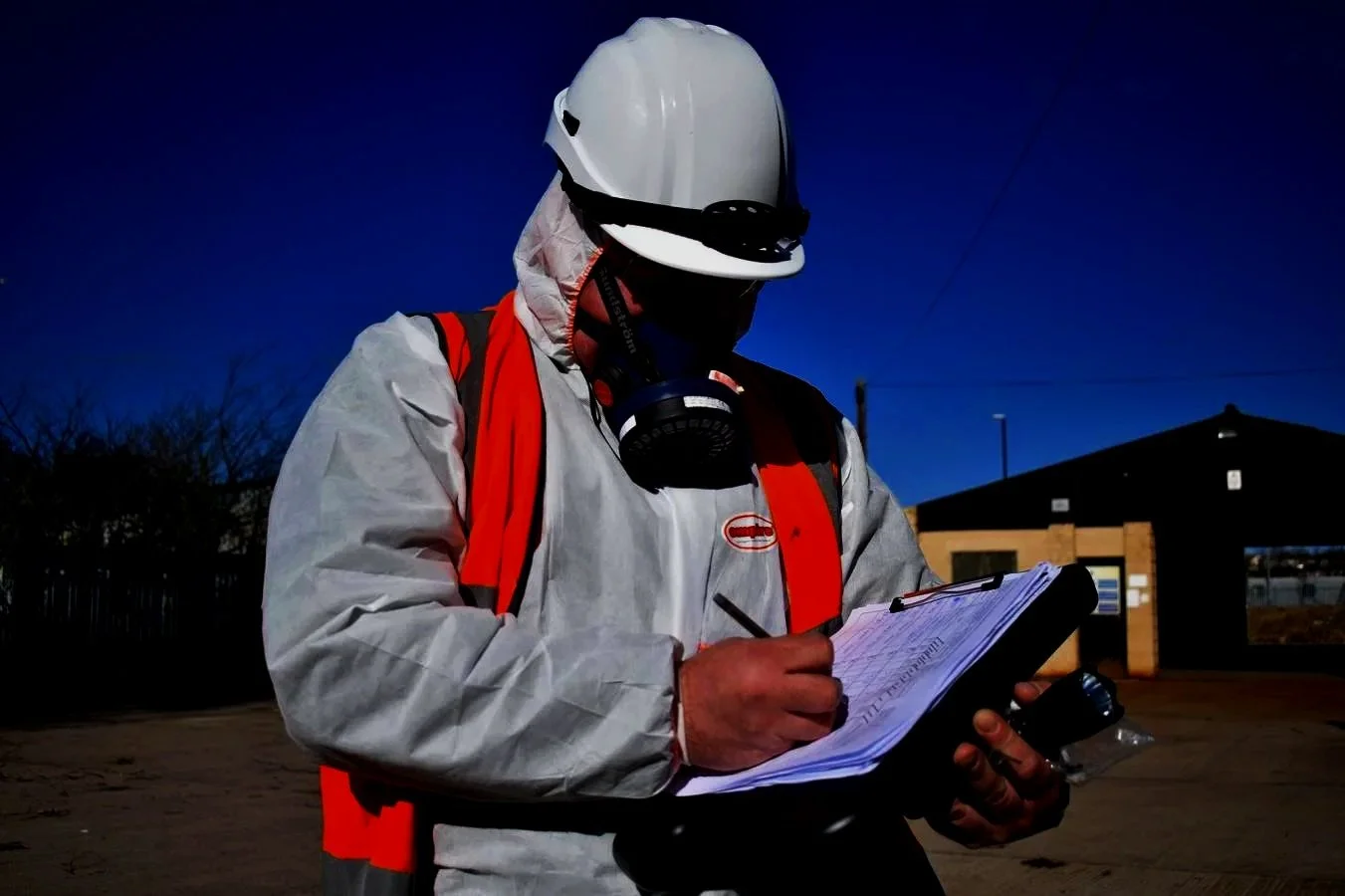
Asbestos air monitoring and four-stage clearance in London
Background, leak, reassurance, personal and clearance air monitoring across London and Greater London, together with formal four-stage clearance and Certificates for Reoccupation where the complete process applies and all applicable stages are passed.
Stop the activity, keep people away where reasonably practicable and avoid sweeping or using a domestic vacuum. An air test does not replace immediate control of the source, debris and affected area.
Different air tests answer different project questions
Air monitoring should be selected from the decision the result needs to support rather than added automatically.
Background monitoring
Establish a reference airborne fibre concentration before relevant work where a baseline is justified by the project circumstances.
Leak monitoring
Assess defined positions outside a controlled enclosure while relevant asbestos work is being carried out.
Reassurance monitoring
Provide airborne fibre information after a defined disturbance, remedial activity or controlled cleaning where reassurance testing is appropriate.
Personal monitoring
Sample within a worker's breathing zone during a defined task to support exposure assessment and review of controls.
Four-stage clearance is more than an air test
Where formal four-stage clearance applies, the process is sequential. Each applicable stage must be satisfactory before the analyst progresses.
1. Preliminary check
Review site condition, job completeness, enclosure readiness, transit arrangements and supporting information.
2. Thorough visual
Inspect the enclosure and work area carefully for visible asbestos debris, dust, residue and incomplete cleaning.
3. Clearance air sampling
After the visual stage passes, undertake the prescribed disturbance and air-sampling procedure where applicable.
4. Final assessment
Assess the former enclosure area after dismantling before completing the handover and Certificate for Reoccupation process.
Below 0.010 f/ml — a clearance indicator, not “zero asbestos”
HSG248 requires applicable Stage 3 clearance air sampling to achieve an airborne fibre concentration below 0.010 fibres per millilitre using the prescribed method. The clearance indicator is a transient measure of cleanliness, not normal airborne fibre levels.
Stage 3 clearance indicator
<0.010 fibres/ml (f/ml). A satisfactory air result alone does not complete the four-stage clearance.
GB workplace control limit
0.1 fibres/ml averaged over four hours. This is a separate legal workplace exposure benchmark and is not a safe exposure level.
Define the monitoring question before the analyst arrives
Define the purpose
Confirm whether the requirement is background, leak, reassurance, personal, clearance or formal four-stage clearance.
Send project information
Provide the site address, asbestos material, plan of work, enclosure details, date, shift pattern and occupied or sensitive areas.
Agree the strategy
ASM confirms attendance, sampling locations, timing, analytical scope, reporting and communication arrangements.
Monitor and report
The analyst records conditions, collects air samples, analyses the filters using applicable controlled procedures and reports the outcome.
Air monitoring for occupied property, removal work and defined reassurance questions
London analytical work ranges from formal licensed-removal clearances to occupied-property monitoring, construction interfaces and reassurance after defined incidents. The monitoring strategy should reflect the actual work, location, occupancy and question being asked.
Offices, hotels & retail
Central London work may need attendance planned around tenants, security, loading restrictions, sensitive areas, phased works and out-of-hours programmes.
Healthcare, education & public buildings
Occupied sensitive environments need monitoring objectives, access arrangements and communication routes agreed before attendance.
Construction & unexpected disturbance
Reassurance monitoring may form part of the response, but it should not replace source identification, suitable cleaning or controlled remedial action where those are still required.
London and Greater London analytical support
ASM London Office
3rd Floor45 Albemarle Street
Mayfair
London
W1S 4JL
London:
020 3004 4184
Email:
survey@asbestosSM.co.uk
National:
0330 433 9680
Monday–Friday · 08:00–18:00
UKAS accreditation no. 32982
London & Greater London coverage
Mayfair, Westminster, Soho, Marylebone, Fitzrovia, Holborn, City of London, Canary Wharf, Camden, Islington, Hackney, Kensington, Chelsea, Hammersmith, Fulham, Southwark, Lambeth, Wandsworth, Battersea, Clapham, Greenwich, Lewisham, Croydon, Kingston upon Thames, Richmond, Ealing, Hounslow, Brent, Barnet, Enfield, Waltham Forest, Newham, Barking and Dagenham, Bromley, Harrow and Hillingdon.
Attendance is subject to project requirements, scope, access, timing and analyst availability.
ASM holds UKAS accreditation number 32982 for defined inspection and testing activities. Current UKAS schedules define the precise accredited asbestos-fibre-in-air and clearance scope and locations.
London services linked to analytical attendance
Asbestos Air Monitoring London FAQs
What types of asbestos air monitoring are available in London?
What is the Stage 3 clearance indicator?
Is 0.010 f/ml the workplace control limit?
Does a low air test prove a building is asbestos-free?
When is a Certificate for Reoccupation issued?
Can reassurance monitoring prove that nobody was exposed earlier?
Is air monitoring required after every asbestos-removal job?
Define what the air test needs to answer
Send the London site address, asbestos material, removal or incident details, plan of work where applicable, enclosure information, monitoring objective, date and shift requirements. ASM can confirm the analytical scope and attendance availability.