

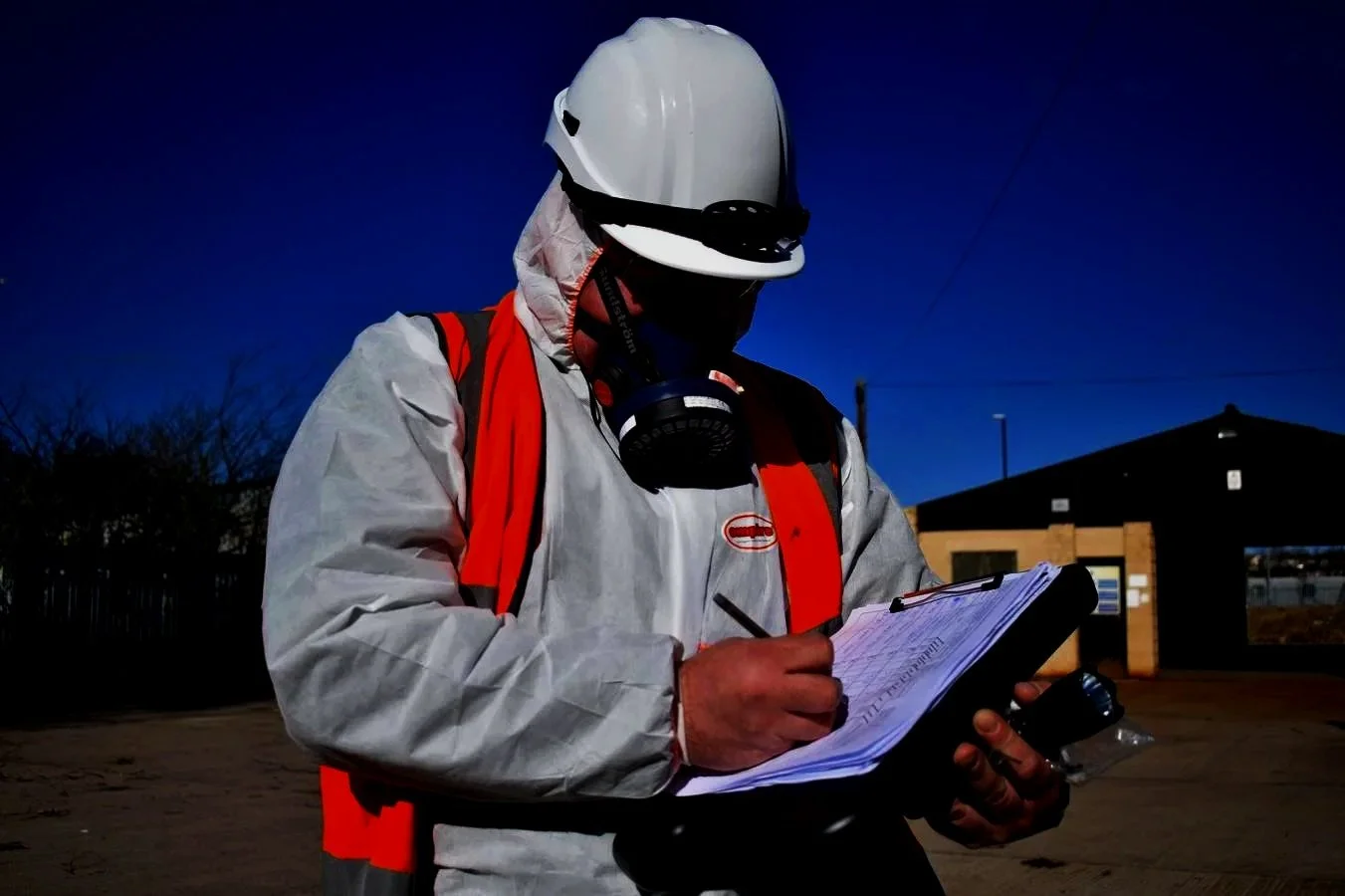
Asbestos air monitoring and four-stage clearance in Derby
Arrange asbestos air monitoring or the applicable clearance service for a Derby project. Define the analytical question, work area, occupation and handover requirements. Air results, bulk identification and survey findings serve different purposes, with an independent client analytical appointment where formal clearance is required.
Stop the activity, keep people away where reasonably practicable and avoid sweeping or using a domestic vacuum. An air test does not replace immediate control of the source, debris and affected area.
Different air tests answer different project questions
Air monitoring should be selected from the decision the result needs to support rather than added automatically.
Background monitoring
Establish a reference airborne fibre concentration before relevant work where a baseline is justified by the project circumstances.
Leak monitoring
Assess defined positions outside a controlled enclosure while relevant asbestos work is being carried out.
Reassurance monitoring
Provide airborne fibre information after a defined disturbance, remedial activity or controlled cleaning where reassurance testing is appropriate.
Personal monitoring
Sample within a worker's breathing zone during a defined task to support exposure assessment and review of controls.
Air monitoring and clearance for Derby projects
Asbestos air monitoring answers a defined analytical question under the conditions assessed. The appropriate instruction may concern background, leak, reassurance or personal monitoring, or a formal clearance process where required. Tell ASM why the evidence is needed so the service can be matched to the work.
A Derby city-centre office refit, a working industrial unit and a domestic removal project have different occupation and access arrangements. Those circumstances help plan attendance, but they do not by themselves determine which test or clearance procedure is appropriate.
Air monitoring does not identify every asbestos-containing material in a building and does not replace a survey before intrusive work. A result also needs to be interpreted within its location, timing, method and limitations rather than treated as a permanent guarantee about future conditions.
Where formal clearance applies, the client should arrange the independent analytical appointment. Confirm the current applicable UKAS schedule, the work phase, site-readiness requirements and reporting needed for handover before fixing the attendance.
Confirm how a change of site contact will be communicated during a phased Derby project. The analytical organisation needs a person who can provide authorised access and accurate readiness information for the booked area. Keep that practical arrangement separate from the analyst’s independent judgement about the assessment and its outcome.
Four-stage clearance is more than an air test
Where formal four-stage clearance applies, the process is sequential. Each applicable stage must be satisfactory before the analyst progresses.
1. Preliminary check
Review site condition, job completeness, enclosure readiness, transit arrangements and supporting information.
2. Thorough visual
Inspect the enclosure and work area carefully for visible asbestos debris, dust, residue and incomplete cleaning.
3. Clearance air sampling
After the visual stage passes, undertake the prescribed disturbance and air-sampling procedure where applicable.
4. Final assessment
Assess the former enclosure area after dismantling before completing the handover and Certificate for Reoccupation process.
Below 0.010 f/ml — a clearance indicator, not “zero asbestos”
HSG248 requires applicable Stage 3 clearance air sampling to achieve an airborne fibre concentration below 0.010 fibres per millilitre using the prescribed method. The clearance indicator is a transient measure of cleanliness, not normal airborne fibre levels.
Stage 3 clearance indicator
<0.010 fibres/ml (f/ml). A satisfactory air result alone does not complete the four-stage clearance.
GB workplace control limit
0.1 fibres/ml averaged over four hours. This is a separate legal workplace exposure benchmark and is not a safe exposure level.
Define the monitoring question before the analyst arrives
Define the purpose
Confirm whether the requirement is background, leak, reassurance, personal, clearance or formal four-stage clearance.
Send project information
Provide the site address, asbestos material, plan of work, enclosure details, date, shift pattern and occupied or sensitive areas.
Agree the strategy
ASM confirms attendance, sampling locations, timing, analytical scope, reporting and communication arrangements.
Monitor and report
The analyst records conditions, collects air samples, analyses the filters using applicable controlled procedures and reports the outcome.
Analytical planning around Derby work phases
An enclosure within an operating premises
Identify the analytical purpose, adjacent occupation and the stage of the removal programme. Provide plans and access arrangements to the appointed analytical organisation. Leak monitoring, personal monitoring and formal clearance answer different questions and should not be booked as interchangeable air tests.
Where formal clearance applies, the client should independently appoint the analytical organisation. Programme coordination must preserve the analyst’s independent assessment.
A shutdown ending before the next shift
Allow for cleaning, readiness checks, applicable clearance stages and the possibility that further work is required. A booked attendance time is not a guaranteed release time. Tell the analyst about changes in the enclosure, work area or adjacent activity before assessment.
The receiving site manager should retain the relevant report and understand its location and conditions. A result from one phase should not be applied automatically to a later changed work area.
Appoint the analyst with clear independence
Where formal site clearance certification applies, HSE advises the building owner or client to independently source and employ the analyst. The analyst’s appointment and reporting should be clear even where the removal programme is coordinated with other contractors.
Provide the removal plan, relevant survey, location and scope, proposed enclosure arrangements, programme and required evidence. Agree when the site will be ready, who provides access and how any failed stage or reattendance will be managed.
Read HSE guidance on putting the management plan into action.
Derby analytical records and phased handovers
Agree the recipient and intended use of each report. The client, facilities manager and refurbishment contractor may need the evidence at different stages, but the report must remain connected to the same assessed work area and conditions.
Where a project releases individual floors or units in phases, identify each boundary consistently across the work plan, analytical record and handover. Do not extend a result from one completed zone to a later phase that has not undergone the required process.
If the layout, containment or programme changes, tell the analytical organisation before attendance. It may need to review the instruction, access or method. Avoid treating a booking as fixed evidence that the site will be ready on that date.
For formal clearance, confirm the appropriate readiness and inspection process with the responsible parties. A following contractor’s deadline should not determine whether the required assessment is complete or how its outcome is reported.
Keep reports with the removal and management records, including remaining material and limitations. For a Derby portfolio, retain separate property and work-area references so an analytical result is not reused for another address or a different activity.
Plan analytical attendance around readiness and the work conditions
The analyst needs a site that is ready for the commissioned task. For formal clearance, communicate the work boundary, relevant plan of work, progress and any changes before the booked attendance. Make sure the people responsible for site access and preparation understand that a programme date does not establish successful completion.
For monitoring during a Derby industrial activity, specify the operation and conditions the sampling should assess. The sampling location, duration and work occurring at the time matter to interpretation. A measurement cannot be assumed to represent different activities, locations or later conditions without a suitable basis.
Agree reporting recipients and any immediate escalation needed if a stage fails or conditions differ from the brief. The client, removal contractor and analyst should understand who addresses outstanding issues, who requests repeat attendance and how the release of the work area is controlled.
Keep the analytical evidence with the removal or project records. Where a material-identification question remains, commission the appropriate bulk investigation rather than relying on air results to answer it.
What the analytical record should explain
- The client, site and defined purpose of the instruction.
- The sampling locations, timing and relevant work or site conditions.
- The applicable method, result and limitations.
- The clearance stages and outcome where formal clearance applies.
- Outstanding issues or repeat work required before handback.
- Who receives and retains the records for the project.
Use the removal service for planning connected work and bulk testing when the question concerns material identification.
Read the Derby analytical record against the work assessed
Purpose and location
The report should make clear why monitoring was undertaken and the locations and activity assessed. A background result, a personal exposure measurement and a clearance-stage result are not interchangeable. The site contact should be able to connect each record to the correct phase, enclosure or work area.
Conditions at assessment
Interpret the result with the method, timing and relevant site circumstances. Changes in activity, containment or adjacent work may require further assessment. An earlier result should not become a general assurance about a later changed process or an unassessed part of the premises.
Formal clearance evidence
Where the full process applies, satisfactory completion concerns all required stages. The visual assessment and other site checks are significant parts of that evidence. A stand-alone fibre count should not be presented as the complete Certificate for Reoccupation process.
Communication and retained materials
Agree who receives the records and how unsatisfactory findings or delays are communicated. The site manager should retain any relevant removal information and updated register alongside the analytical documents. Air-monitoring evidence does not erase materials intentionally left under management elsewhere in the building.
Derby analytical support and attendance
ASM · Derby service enquiries
Site attendance across Derby by prior arrangement. Contact the team with your property address, service requirement and target dates.
National enquiries
0330 433 9680
Monday–Friday · 08:00–18:00
Derby analytical attendance
Derby city centre, Allestree, Alvaston, Chaddesden, Darley Abbey, Littleover, Mickleover, Sinfin and Spondon.
Provide the full postcode, building use and intended work. Attendance, access, programme and service scope are agreed for the individual instruction. Nearby Derbyshire enquiries can be assessed from the site details.
Monitoring objectives, site readiness, enclosure arrangements and analyst availability determine the attendance plan. UKAS accreditation 32982 applies to the activities and locations in the current inspection and testing schedules.
Derby services linked to analytical attendance
Asbestos Air Monitoring Derby FAQs
How much allowance should a Derby shutdown make for clearance attendance?
Agree the removal programme, readiness checks and applicable analytical process with the appointed organisation. Allow for further cleaning or preparation if needed. There is no universal duration or guaranteed release time; the programme must accommodate the actual condition and assessment.
How should monitoring be arranged for a phased Derby project?
Provide the current layout, phase boundaries, work plan and adjacent occupation. Agree access, site readiness, reporting and the analytical purpose with the competent organisation. Keep each result tied to its assessed area and conditions rather than extending it to later phases automatically.
Can ASM provide air monitoring in Derby?
Yes, subject to the agreed instruction, programme and applicable accredited scope. Describe the purpose, site and work conditions so the correct monitoring service can be selected.
Does every removal need four-stage clearance?
No. Requirements depend on the work. Where formal clearance applies, the full applicable process must be completed rather than substituting a simple reassurance air test.
Who should appoint the clearance analyst?
HSE advises the building owner or client to independently source and employ the analyst for formal clearance certification. Confirm reporting and programme arrangements before the work.
Can an air test confirm my house contains no asbestos?
No. Air monitoring measures conditions for its defined sampling purpose and period. It does not identify all bulk materials or prove absence of asbestos throughout a building.
What happens if a clearance stage fails?
The issue must be addressed and the necessary checks repeated before the applicable process can be satisfactorily completed. Agree readiness and reattendance arrangements when commissioning the work.
Is air monitoring the same as dust or general indoor-air testing?
No. Define the contaminant, purpose and method required. An asbestos analytical instruction should not be assumed to assess every form of dust, contamination or indoor-air concern.
Can clearance be booked before the removal programme is finalised?
An indicative booking can be discussed, but the scope, readiness and access arrangements must be confirmed. Allow for communication about changes and the possibility that outstanding work prevents clearance from proceeding.
Does a satisfactory result apply to neighbouring rooms?
Only interpret a result within its defined sampling and work-area scope. It should not be extended to unrelated rooms, materials or later activities without an appropriate basis.
What information does the analyst need before attending?
Provide the monitoring objective, address, work area, relevant survey and plan of work where applicable, programme, access arrangements and reporting contacts. Clarify how changes or unsuccessful stages will be managed.
Can the same air result be used for a different work activity?
Not automatically. Results reflect their sampling conditions, locations, timing and purpose. A different task or operating condition may need a separate assessment or monitoring instruction.
Define what the air test needs to answer
Send the Derby site address, asbestos material, removal or incident details, plan of work where applicable, enclosure information, monitoring objective, date and shift requirements. ASM can confirm the analytical scope and attendance availability.