

Asbestos Insulating Board Removal Cost UK
Current ASM budgeting guidance for asbestos insulating board removal. Substantive AIB removal typically starts within a broad £140–£350+/m² + VAT range, but enclosure design, site access, decontamination arrangements, analytical clearance and the overall complexity of the licensed asbestos setup can have a greater impact on cost than the area of AIB alone.
How much does asbestos insulating board removal cost?
For early-stage budgeting, ASM uses approximately £140–£350+/m² + VAT for substantive AIB removal. Unlike lower-risk materials such as asbestos cement or floor tiles, however, AIB should not be finally priced simply by multiplying the measured area by a square-metre rate.
The lower end is more likely on larger, comparatively straightforward removal areas where a single efficient licensed setup can serve a substantial quantity of AIB.
Complex, restricted, damaged, phased or small licensed projects can exceed £350/m² because the project still requires extensive site setup and controls.
Why the £/m² figure is only the starting point
AIB removal creates significant fixed project costs before the first board is removed.
Depending on the project, the quotation can include:
- licensed asbestos-removal labour;
- enclosure construction;
- airlocks and baglocks;
- negative-pressure equipment;
- decontamination unit;
- transit arrangements;
- HSE/enforcing-authority notification;
- scaffolding or specialist access;
- service isolation;
- hazardous-waste arrangements;
- analytical attendance;
- four-stage clearance where applicable;
- reinstatement interfaces.
ASM does not issue a final substantive AIB quotation from area alone
£140–£350+/m² is provided so clients, surveyors and project teams have a realistic early budgeting range. ASM's policy is to assess substantive AIB projects individually before the final fixed quotation is issued.
Example AIB removal budget calculations
These figures simply apply the £140–£350+/m² guide range to different quantities of AIB. They are mathematical budgeting examples only and are deliberately not presented as fixed quotations.
A small licensed project may actually exceed this guide because enclosure, DCU, analytical and mobilisation costs are concentrated across a small area.
Initial mathematical range before considering enclosure design, location, access and number of work areas.
Larger contiguous areas may allow fixed licensed-site costs to be spread over more square metres.
Useful as an initial allowance only. A site-specific scope remains necessary before procurement or contract budgeting.
A 10m² project can cost more per m² than a 100m² project
The licensed enclosure, decontamination unit, negative-pressure equipment, notification, analytical attendance and mobilisation requirements do not reduce proportionally just because the asbestos quantity is small.
What we assess before confirming the AIB removal price
The regulatory requirement is for asbestos work to be suitably assessed and planned. ASM's commercial policy for substantive AIB removal is to complete an individual project/site assessment before confirming the final fixed price.
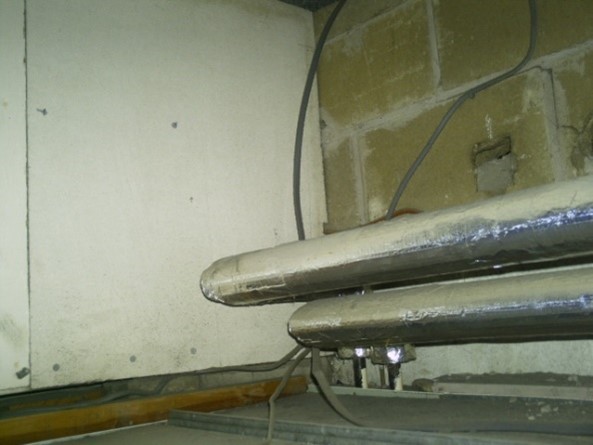
AIB may continue far beyond the visible panel
AIB commonly occurs within ceiling voids, service risers, partitions, bulkheads and fire-protection systems.
A visible panel may form only part of a larger firebreak or lining system.
This can affect:
- the actual asbestos quantity;
- enclosure size;
- ceiling access;
- service isolation;
- waste quantities;
- removal duration;
- clearance time;
- reinstatement requirements.
Where AIB is being removed ahead of extensive building work, a suitable refurbishment or demolition asbestos survey should define the affected building fabric sufficiently for the removal project to be planned.
What determines where the AIB price sits within the range?
| Cost factor | Lower complexity | Higher complexity |
|---|---|---|
| Quantity | Large continuous area | Very small licensed removal quantity |
| Work areas | Single enclosure | Multiple separate enclosures/phases |
| AIB condition | Sound and relatively intact | Damaged, broken or contaminated area |
| Fixings | Accessible fixings | Heavy, concealed or difficult fixings |
| Access | Ground-level accessible work | High-level, shaft, roof void or restricted area |
| Enclosure | Simple rectangular work area | Complex shapes, penetrations and interfaces |
| Occupation | Vacant building | Occupied school, hospital, office or residential building |
| Programme | Normal continuous working | Night, weekend, restricted or phased working |
| Services | Minimal interfaces | Electrical, mechanical and fire systems within AIB |
| Clearance | Straightforward enclosure | Complex area requiring extensive visual inspection |
| Reinstatement | Separate follow-on works | Immediate ceiling, partition or fire-protection replacement |
Most substantial AIB removal requires a licensed contractor
HSE treats asbestos insulating board differently from bonded materials such as asbestos cement. Most significant AIB removal is higher-risk work requiring a licensed contractor.
| Activity | Typical position | Effect on pricing |
|---|---|---|
| AIB partition removal | Normally licensed asbestos work. | Licensed setup, notification, enclosure and clearance need to be allowed for. |
| Multiple AIB ceiling tiles | Substantive ceiling removal will normally require licensed asbestos-removal arrangements. | Working at height and enclosure layout can materially affect the project. |
| AIB firebreak removal | Significant removal normally falls into licensed work. | Ceiling void access and services frequently increase complexity. |
| Damaged AIB/debris | Higher fibre-release potential and normally licensed. | Additional cleaning, enclosure and contamination controls can increase cost. |
| Single minor AIB task | Certain strictly controlled activities can potentially fall within HSE's limited non-licensed arrangements. | Must be individually assessed and should not simply be priced using the substantive licensed-removal model. |
Do not assume a small AIB area is automatically non-licensed
HSE provides task-specific Asbestos Essentials guidance for limited activities such as removing a single small panel or accessing loosely fixed panels. Those exceptions are deliberately narrow. Most substantive removal programmes remain licensed work.
Licensed AIB work normally needs advance notification
Licensable asbestos work must normally be notified to the appropriate enforcing authority in advance, with the standard notification period normally being at least 14 days before work starts.
This affects both programme and cost because a substantial AIB project needs time for:
Confirm the material, location, quantity and proposed extent of disturbance.
Establish access, enclosure, DCU, waste route, services and building restrictions.
Prepare the project-specific plan of work and complete the required licensed-work notification.
Mobilise the licensed removal operation, complete the work and progress through the required clearance and handover.
Four-stage clearance can form part of the project cost
Where licensed AIB removal takes place in an enclosure requiring formal clearance, the project needs to allow sufficient time and resources for the independent four-stage clearance process.
Site condition, enclosure, documentation and job completeness are checked before clearance progresses.
The analyst conducts a detailed visual inspection for remaining asbestos, dust and debris.
Air monitoring is completed where required by the applicable clearance procedure.
The area is assessed after enclosure dismantling before successful reoccupation documentation is completed.
See ASM Asbestos Air Monitoring & Four-Stage Clearance .
Failed clearance can affect both programme and cost
The licensed contractor must thoroughly clean the work area before it is offered for independent clearance. If the area does not pass the required stage, further contractor cleaning and repeat analytical attendance can affect the programme and final project cost.
What should an AIB removal quotation make clear?
Licensed removal scope
- Defined AIB removal area
- Site mobilisation
- Detailed plan of work
- Licensed-work notification
- Enclosure construction
- Airlocks and baglocks
- Negative-pressure equipment
- DCU arrangements
- RPE/PPE
- Controlled AIB removal
- Final asbestos cleaning
- Asbestos waste arrangements
- Completion documentation
Confirm separately
- Scaffolding or MEWP requirements
- Electrical isolation
- Fire-alarm alterations
- Mechanical-service isolation
- Independent analytical costs
- Four-stage clearance costs
- Out-of-hours working
- Temporary protection
- Replacement ceilings
- Replacement partitions
- Fire protection reinstatement
- Making good and decoration
Small AIB removal jobs can have the highest £/m² cost
A common mistake is to assume that a very small AIB removal project must automatically be inexpensive.
AIB removal and the wider construction cost
AIB frequently forms part of ceilings, firebreaks, partitions, soffits and service enclosures. Removing it can therefore create immediate construction and reinstatement requirements.
Licensed removal is delivered within F&I Group through Flowing Construction Services under licence number 202505985, while wider group capability can help coordinate access, roofing, refurbishment and other related project requirements.
Explore F&I Group ServicesPotential wider project costs
- Scaffolding and specialist access
- Temporary works
- Soft strip
- Ceiling replacement
- Partition replacement
- Fire-protection reinstatement
- Roofline or soffit reinstatement
- Service alterations
- Roofing interfaces
- Final building reinstatement
UKAS-accredited inspection and analytical support
Asbestos Surveying and Monitoring Ltd holds UKAS accreditation number 32982 for defined inspection and testing activities within its current accredited schedules.
Depending on the project and appropriate appointment arrangements, ASM can provide relevant surveying, bulk analysis and analytical services supporting an AIB project.
Asbestos removal itself is not a UKAS-accredited service
UKAS accreditation relates to the defined inspection and testing activities included within ASM's accredited scope. Licensed asbestos removal is a separate activity.
AIB removal, surveys, air monitoring and other materials
AIB removal cost FAQs
How much does AIB removal cost per square metre?
Can AIB removal cost more than £350/m²?
Why does ASM need to assess the site before giving the final price?
How much would 10m² of AIB cost to remove?
How much would 50m² of AIB cost to remove?
Why can a larger AIB project have a lower cost per square metre?
Does the £140–£350/m² figure include four-stage clearance?
Does AIB removal require a licensed asbestos contractor?
Does licensed AIB work need 14 days' notice?
Does AIB removal always need an enclosure?
Is air monitoring included in AIB removal costs?
What makes an AIB enclosure expensive?
Can ASM price AIB removal from photographs?
What should I send ASM before arranging the assessment?
HSE guidance relevant to AIB pricing and project planning
The work category and method should be determined from the actual material, condition, task, duration and likely fibre release. The commercial price then needs to reflect the controls required by that assessment.
Need an accurate AIB removal price?
Use £140–£350+/m² as an early budgeting range, then send ASM the asbestos survey, photographs and approximate removal area. We will review the project and arrange an individual assessment of the AIB, enclosure requirements, DCU position, access, waste route, analytical requirements and wider site constraints before confirming the final fixed quotation.