

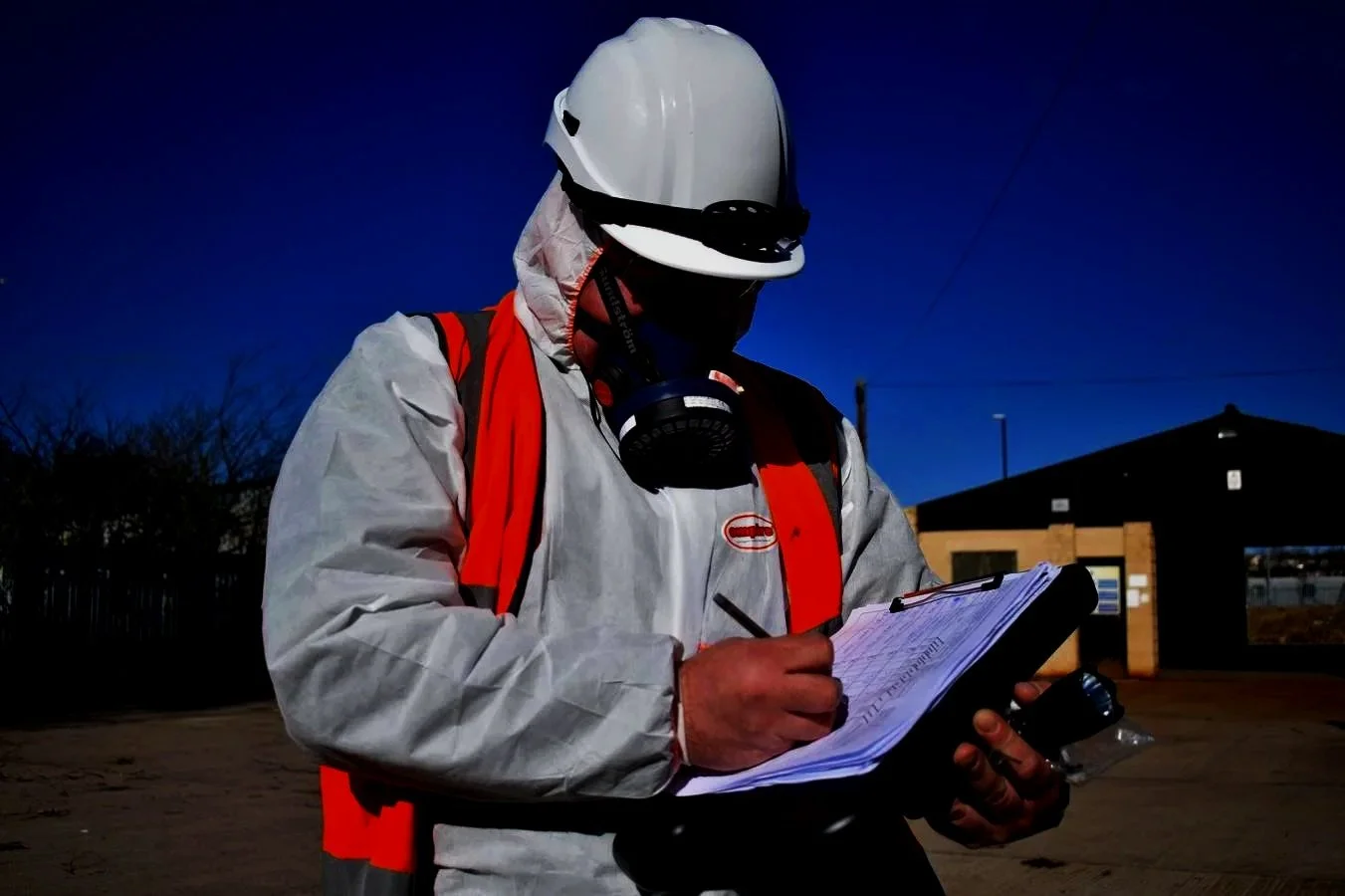
Asbestos air monitoring and four-stage clearance in Leicester
Asbestos air monitoring and four-stage clearance for Leicester work programmes and defined analytical questions. Agree the monitoring objective, commissioning arrangements and site access, with the required evidence built into the handover process.
Stop the activity, keep people away where reasonably practicable and avoid sweeping or using a domestic vacuum. An air test does not replace immediate control of the source, debris and affected area.
Different air tests answer different project questions
Air monitoring should be selected from the decision the result needs to support rather than added automatically.
Background monitoring
Establish a reference airborne fibre concentration before relevant work where a baseline is justified by the project circumstances.
Leak monitoring
Assess defined positions outside a controlled enclosure while relevant asbestos work is being carried out.
Reassurance monitoring
Provide airborne fibre information after a defined disturbance, remedial activity or controlled cleaning where reassurance testing is appropriate.
Personal monitoring
Sample within a worker's breathing zone during a defined task to support exposure assessment and review of controls.
Four-stage clearance is more than an air test
Where formal four-stage clearance applies, the process is sequential. Each applicable stage must be satisfactory before the analyst progresses.
1. Preliminary check
Review site condition, job completeness, enclosure readiness, transit arrangements and supporting information.
2. Thorough visual
Inspect the enclosure and work area carefully for visible asbestos debris, dust, residue and incomplete cleaning.
3. Clearance air sampling
After the visual stage passes, undertake the prescribed disturbance and air-sampling procedure where applicable.
4. Final assessment
Assess the former enclosure area after dismantling before completing the handover and Certificate for Reoccupation process.
Below 0.010 f/ml — a clearance indicator, not “zero asbestos”
HSG248 requires applicable Stage 3 clearance air sampling to achieve an airborne fibre concentration below 0.010 fibres per millilitre using the prescribed method. The clearance indicator is a transient measure of cleanliness, not normal airborne fibre levels.
Stage 3 clearance indicator
<0.010 fibres/ml (f/ml). A satisfactory air result alone does not complete the four-stage clearance.
GB workplace control limit
0.1 fibres/ml averaged over four hours. This is a separate legal workplace exposure benchmark and is not a safe exposure level.
Define the monitoring question before the analyst arrives
Define the purpose
Confirm whether the requirement is background, leak, reassurance, personal, clearance or formal four-stage clearance.
Send project information
Provide the site address, asbestos material, plan of work, enclosure details, date, shift pattern and occupied or sensitive areas.
Agree the strategy
ASM confirms attendance, sampling locations, timing, analytical scope, reporting and communication arrangements.
Monitor and report
The analyst records conditions, collects air samples, analyses the filters using applicable controlled procedures and reports the outcome.
Leicester air monitoring coordinated with the release of work areas
The analytical question comes first
Specify whether the requirement concerns a defined monitoring task or clearance associated with removal. Supply the work plan, material evidence and layout. The analyst’s method and sampling locations should address that objective; a result from one place and time is not a building-wide guarantee or proof that all suspect materials have been identified.
Occupied industrial and mixed-use premises
Explain adjacent occupation, working equipment and restrictions on reaching relevant sampling positions. Identify who will arrange access and communicate with the other users of the building. Commission the analytical service early enough for those arrangements to be resolved rather than treating monitoring as an unplanned addition at the end.
Following trades and restart decisions
Where four-stage clearance is required, build the stages and any corrective work into the programme. Agree report recipients and the person responsible for releasing the area. A production restart or construction handover should follow satisfactory completion of the required process, not merely the provisional finishing time in a schedule.
UKAS-accredited inspection and testing, with the scope kept clear
Asbestos Surveying and Monitoring Ltd holds UKAS accreditation number 32982 for defined inspection activities to ISO/IEC 17020 and testing activities to ISO/IEC 17025. The current schedules define the accredited activities and locations. Bulk asbestos identification is undertaken at the Sunderland laboratory.
Accreditation applies to the organisation and its defined activities. Asbestos removal, preparation of management plans, watching briefs and soil remediation are not described as UKAS-accredited work.
Check ASM’s current UKAS schedules (search 32982) ↗ · Sunderland laboratory and submission guidance
What the analytical evidence should explain
Confirm the deliverables when agreeing the commission, then review the information against the actual property or work scope.
- The purpose, location and timing of the monitoring.
- The sampling conditions and relevant method, results and limitations.
- The relationship between the monitoring and the work or incident being assessed.
- For formal clearance, the outcome of all applicable stages and the final reoccupation documentation; a fibre count alone is not the full process.
If a location, quantity or assumption is unclear, resolve it before the relevant maintenance or construction stage. Keep reports and completion evidence together so the next contractor can understand what was assessed, what changed and what still needs attention.
Brief the Leicester analytical attendance
- The monitoring purpose and relevant survey and removal information.
- Work-area layout, sampling access and neighbouring occupation.
- Commissioning contact and report recipients.
- Handover criteria and the plan for any additional cleaning or corrective work.
Agree a project-specific quotation
The cost depends on the actual scope, available evidence, site access, reporting requirements and programme. Send the relevant survey, register, analytical records or investigation information before the commission is agreed. Identify which services are already appointed and who will authorise any additional work.
Agree the deliverables and exclusions in writing. Site support, repeat attendance, laboratory work, monitoring and follow-up reporting should be identifiable within the quotation so the client can compare equivalent proposals.
Leicester service coverage and enquiries
ASM · Leicester service enquiries
Site attendance by prior arrangement. Send the property address, required service and target dates.
National enquiries
0330 433 9680
Monday–Friday · 08:00–18:00
Leicester analytical attendance
Leicester city centre, St George’s, Belgrave, Highfields, Braunstone, Beaumont Leys, Evington and surrounding areas.
Agree the monitoring objective, site readiness, enclosure arrangements and analyst attendance with the project team.
Discuss Leicester projects in the city centre, Belgrave, Highfields, Evington, Aylestone, Knighton, Stoneygate, Humberstone and the West End. For surrounding locations such as Oadby, Wigston, Birstall, Thurmaston, Syston, Glenfield, Anstey and Leicester Forest East, provide the exact postcode and service required. These enquiries are assessed against scope, access and programme; the wider urban area is not the same as Leicester City Council’s boundary.
Unexpected asbestos disturbance: next steps · Asbestos found: deciding what happens next · ASM air monitoring across the UK
Leicester services linked to analytical attendance
Asbestos Air Monitoring Leicester FAQs
Which type of asbestos air monitoring do I need?
The choice depends on the question: background, leak, personal, reassurance and clearance monitoring address different conditions. Send the work or incident details so the analytical scope can be defined.
What are the four clearance stages?
Preliminary site and work-completeness checks, a thorough visual inspection, clearance air monitoring and the final assessment after enclosure dismantling.
What is the Stage 3 clearance indicator?
The applicable HSG248 clearance air monitoring result must be below 0.010 fibres per millilitre. A satisfactory air result alone does not complete the four-stage clearance process.
When is a Certificate for Reoccupation issued?
Only after satisfactory completion of all applicable stages of the formal clearance process.
Is an air test required after every removal task?
No. Analytical requirements depend on the material, assessed work category, method, enclosure arrangements and project circumstances.
Can reassurance monitoring prove there was no earlier exposure?
No. It provides evidence for the defined sampling positions, period and conditions. It cannot reconstruct an earlier exposure or replace assessment and control of the source and debris.
Who should appoint the clearance analyst?
HSE strongly recommends that the building owner or client independently sources and employs the analyst for site clearance certification.
Can production restart at the planned end of a clearance visit?
Only after the required clearance and release arrangements have been satisfactorily completed. A provisional time does not replace the necessary stages or any corrective work identified.
Does an air result identify the material above a workshop ceiling?
No. Air monitoring addresses a defined airborne-fibre question under the sampling conditions. Suspect building material needs appropriate inspection and representative bulk analysis.
Can I enquire about a site outside Leicester city?
Yes. Send the address and service required for a surrounding location such as Oadby, Wigston, Birstall, Thurmaston, Syston, Glenfield, Anstey or Leicester Forest East. ASM confirms attendance against scope, access and programme. The relevant council and permissions depend on the site address.
Define what the air test needs to answer
Send the Leicester site address, asbestos material, removal or incident details, plan of work where applicable, enclosure information, monitoring objective, date and shift requirements. ASM can confirm the analytical scope and attendance availability.